
MEDISEARCHER NEWS
United States · HPV & immunotherapy · 1 November 2026
In brief
- The US Food and Drug Administration has granted accelerated approval to Voceryq for adults with recurrent respiratory papillomatosis (RRP), a rare chronic airway disease caused by HPV.
- Voceryq is the first plasmid DNA-based immunotherapy approved in the United States.
- RRP causes recurring papillomas, often around the vocal cords, and some patients require repeated surgeries because removing the growths does not eliminate the underlying HPV infection.
- Voceryq is designed to stimulate an immune response against cells infected with HPV types 6 and 11, the main causes of RRP.
- In the study supporting accelerated approval, 7 of 26 patients (27%) with at least three surgeries before treatment required no surgical intervention during the following year.
- The evidence comes from a small, open-label Phase 1/2 study involving 32 adults rather than a randomized Phase III trial.
- FDA is requiring a confirmatory study involving at least 50 adults and children and at least three years of follow-up to verify the clinical benefit.
- Voceryq is not the first approved immunotherapy for RRP. Papzimeos, a different HPV-targeted immunotherapy, received FDA approval in 2025.
The US Food and Drug Administration has approved a new type of DNA-based immunotherapy designed to reduce repeated surgeries in adults with recurrent respiratory papillomatosis, a rare chronic airway disease caused by human papillomavirus.
Voceryq (doruxapapogene ralaplasmid and lalikinogene sifuplasmid-gxfd) received accelerated approval on 30 October 2026 for reducing the frequency of surgical papilloma excisions in adults with recurrent respiratory papillomatosis, commonly known as RRP.
The approval makes Voceryq the first plasmid DNA-based immunotherapy approved in the United States.
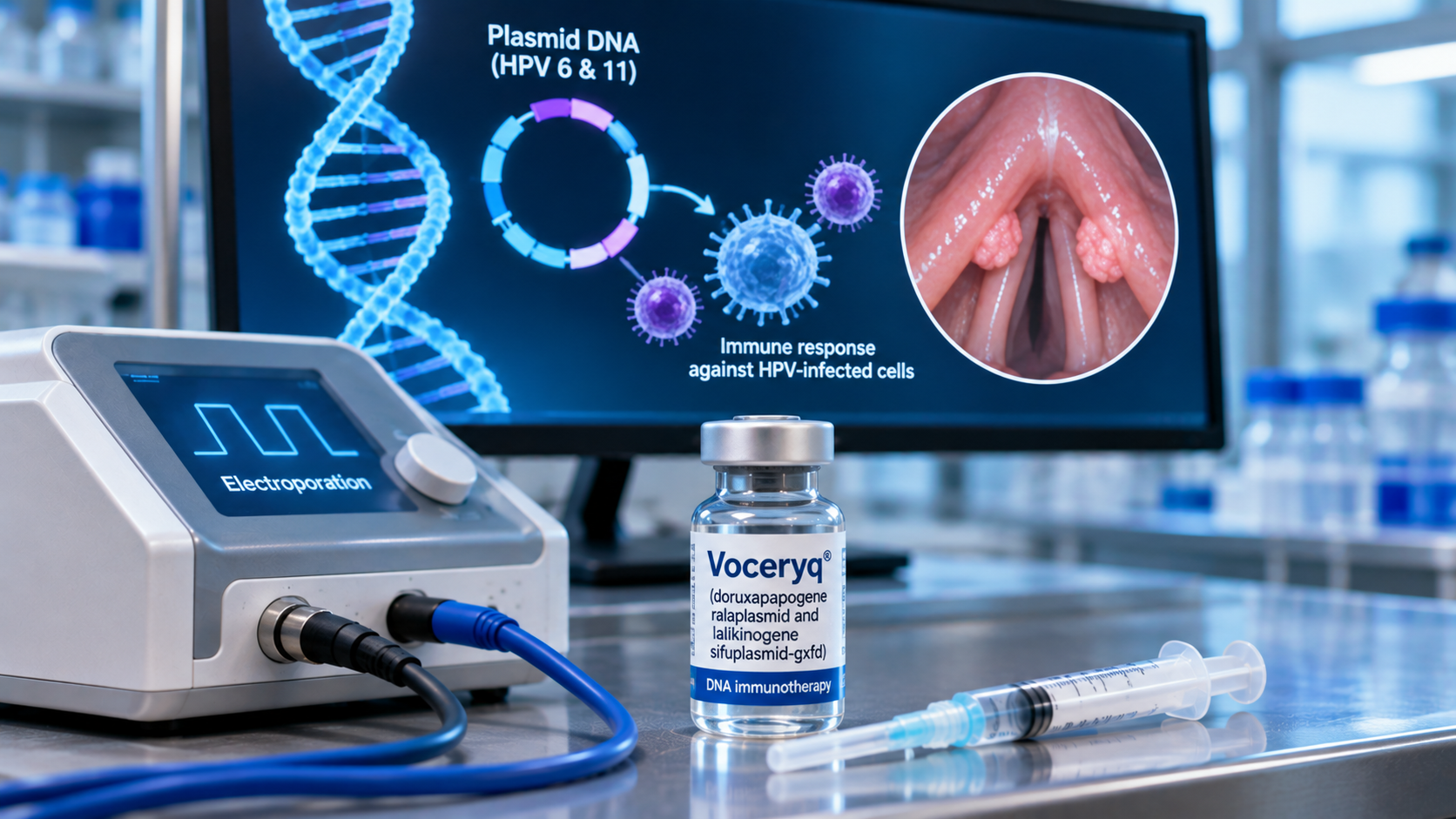
Rather than simply removing recurrent airway growths, the treatment is designed to stimulate the patient’s immune system to recognize and attack cells infected with HPV types 6 and 11, which cause most cases of RRP.
What is recurrent respiratory papillomatosis?
Recurrent respiratory papillomatosis is a rare chronic disease caused by persistent infection with human papillomavirus, primarily HPV types 6 and 11.
The infection causes wart-like growths called papillomas to develop in the respiratory tract, most commonly around the larynx or voice box and particularly on the vocal cords.
Symptoms can include:
- persistent hoarseness;
- voice changes;
- chronic cough;
- difficulty breathing; and
- airway obstruction in severe disease.
Although the papillomas are usually benign, the disease can be extremely disruptive because the growths frequently return after they are removed.
In some cases, papillomas can spread further into the respiratory tract, and RRP carries a risk of malignant transformation over time.
Why can RRP require repeated surgery?
Surgery has traditionally been central to managing recurrent respiratory papillomatosis.
Doctors can surgically remove or debulk the papillomas to restore the airway and improve voice function, but surgery does not eliminate the HPV infection responsible for producing them.
The growths can therefore return.
Some people with aggressive RRP undergo repeated procedures over many years, creating a substantial treatment burden and potentially exposing delicate laryngeal tissue to cumulative damage.
This is what makes HPV-directed immunotherapy particularly interesting: instead of only removing the consequences of infection, the treatment attempts to generate an immune response against HPV-infected cells involved in the underlying disease process.
How does Voceryq work?
Voceryq is a recombinant plasmid DNA-based immunotherapy.
Plasmids are small circular pieces of DNA. The treatment uses two plasmids to deliver genetic instructions into cells.
One contains instructions associated with specific proteins from HPV types 6 and 11. The other encodes interleukin-12 (IL-12), an immune-signalling molecule intended to enhance the immune response.
The aim is to induce HPV-specific T-cell responses capable of recognizing and attacking cells infected with the HPV types responsible for RRP.
Published clinical research has found treatment-induced HPV-specific T-cell responses in patients’ blood and evidence that these immune cells can traffic into papilloma tissue.
Voceryq uses electroporation to deliver the DNA
The method used to administer Voceryq is also unusual.
The treatment is injected into muscle and delivered using the CELLECTRA 5PSP device.
The device applies brief electrical pulses in a process called electroporation.
These pulses temporarily and reversibly create pores in cell membranes, helping the plasmid DNA enter cells.
According to the FDA prescribing information, patients receive a 1 mL intramuscular dose every three weeks for a total of four doses.
A surgical debulking of visible papillomas is performed before the first dose to establish minimal residual disease.
What evidence led to FDA approval?
The FDA based its accelerated approval on an open-label multicentre Phase 1/2 study involving 32 adults with HPV-6 and/or HPV-11-associated recurrent respiratory papillomatosis.
Participants had required at least two surgical interventions to remove papillomas during the year before treatment, including a scheduled procedure when they entered the study.
All participants received four doses of the DNA immunotherapy.
In the peer-reviewed study, 26 of 32 patients (81%) experienced a reduction in the number of surgeries after treatment compared with the preceding year.
The FDA focused its accelerated-approval analysis on patients with a higher baseline surgical burden.
27% of higher-burden patients needed no surgery for a year
Among 26 patients who had required at least three surgeries before treatment, 7 patients — 27% — required no surgical intervention during the first year after treatment.
This is clinically meaningful for a disease in which some patients can become trapped in a cycle of recurring papillomas and repeated operations.
However, it also means that most patients in this group did still require at least one surgical intervention during the first year.
The results therefore should not be interpreted as showing that Voceryq eliminates RRP or removes the need for surgery in every patient.
How strong is the evidence?
The evidence is promising but still limited.
The supporting study was a Phase 1/2 trial involving only 32 adults and was open-label and single-arm. There was no randomized placebo or active-treatment comparison group.
That makes the evidence substantially less definitive than results from a large randomized Phase III trial.
At the same time, the study has been published in a peer-reviewed scientific journal and includes both clinical and immunological findings.
Researchers observed HPV-6 and HPV-11-specific T-cell responses following treatment, and analyses found evidence that treatment-induced T cells reached papilloma tissue.
The combination of reduced surgical burden and biological evidence of an HPV-specific immune response contributed to the rationale for further development of the therapy.
Why did FDA use accelerated approval?
Voceryq received accelerated approval, rather than conventional approval based on definitive confirmatory evidence.
The FDA’s accelerated approval pathway can allow treatments for serious conditions to reach patients on the basis of a surrogate or intermediate clinical endpoint considered reasonably likely to predict clinical benefit.
For Voceryq, the relevant intermediate endpoint is the reduction in surgical procedures required to manage recurrent papillomas.
Continued approval may depend on subsequent studies verifying and describing the treatment’s clinical benefit.
FDA requires a larger confirmatory study
The FDA approval letter sets out a substantial post-marketing requirement.
The manufacturer must conduct an adequate and well-controlled study involving at least 50 adult and paediatric patients with RRP who required three or more surgical interventions during the 12 months before treatment.
The study must evaluate the number of surgeries required for at least three years after treatment and compare outcomes with an appropriate external control group or another scientifically justified threshold.
The FDA says clinical benefit should ultimately be demonstrated through outcomes such as durable elimination of surgical papilloma excisions and improvement in symptoms.
The current regulatory timetable calls for the final study protocol to be submitted by June 2027, study completion by December 2031 and the final study report by August 2032.
This means important questions about how durable the treatment’s effects are should become clearer with longer follow-up.
What side effects occurred with Voceryq?
The most commonly reported adverse reactions identified by the FDA included:
- injection-site reactions;
- headache;
- fatigue;
- hypertension;
- nausea; and
- dizziness.
The peer-reviewed Phase 1/2 study reported treatment-related adverse events in 13 of 32 patients, or 41%, with those events reported as low grade.
The electroporation procedure itself can also cause effects including brief muscle contractions, temporary bleeding, anxiety, lightheadedness or other vasovagal reactions, skin redness and pain at the administration site.
Voceryq is not the first approved treatment for RRP
Although Voceryq is the first plasmid DNA-based immunotherapy approved in the United States, it is important not to confuse that milestone with being the first medicine approved for recurrent respiratory papillomatosis.
In 2025, the FDA approved Papzimeos (zopapogene imadenovec-drba) for adults with RRP.
Papzimeos is also designed to generate an HPV-specific immune response, but it uses a non-replicating adenoviral vector rather than plasmid DNA.
The arrival of Voceryq therefore creates another medical treatment option for a disease that historically relied heavily on repeated surgical management.
There are currently no head-to-head clinical trial data establishing that one of these immunotherapies is superior to the other.
Is Voceryq a cure for HPV or RRP?
No. The current evidence does not justify describing Voceryq as a cure for HPV infection or recurrent respiratory papillomatosis.
The treatment is designed to generate an immune response against HPV-infected cells and has reduced surgical burden in clinical research.
Some patients went at least one year without requiring another operation, but others continued to require surgery.
FDA accelerated approval is specifically for reducing the frequency of surgical papilloma excisions in adults with RRP.
The required confirmatory study is intended in part to establish whether some patients experience durable elimination of the need for surgery and sustained symptomatic improvement.
Can HPV vaccination prevent recurrent respiratory papillomatosis?
Prevention and treatment are different issues.
HPV types 6 and 11 — the principal causes of RRP — are among the HPV types targeted by modern HPV vaccination.
Preventing infection with these HPV types can therefore help prevent diseases associated with them.
However, preventive HPV vaccination should not be confused with Voceryq treatment in someone who already has established RRP.
Voceryq is a therapeutic immunotherapy intended for adults who already have the disease, whereas HPV vaccines are primarily intended to prevent HPV infection and associated disease.
What happens next?
Voceryq’s approval creates another non-surgical treatment option for adults living with recurrent respiratory papillomatosis, but several important questions remain.
The required confirmatory study should provide stronger evidence about how many patients achieve durable reductions in surgery, how long responses last and whether the treatment produces sustained improvements in symptoms.
Including paediatric patients in that study is also significant because RRP can begin during childhood, while the current Voceryq approval is restricted to adults.
Longer-term evidence will also help establish where Voceryq fits alongside Papzimeos, surgery and other approaches used by specialist RRP teams.
Why the Voceryq approval matters
Voceryq represents an important milestone for both RRP treatment and DNA-based medicine.
For patients with aggressive RRP, reducing the frequency of repeated airway surgery could translate into fewer procedures, less disruption and potentially less cumulative damage to structures involved in speech and breathing.
Scientifically, the approval is also notable because plasmid DNA medicines have been investigated for years but had not previously produced an FDA-approved immunotherapy in the United States.
At the same time, the evidence should be kept in perspective.
The pivotal study was small and uncontrolled, only 27% of the higher-surgical-burden group remained surgery-free for the first year, and the FDA is requiring considerably more evidence to confirm durable clinical benefit.
Voceryq is therefore best understood as a promising new treatment option and a significant technology milestone — not evidence that recurrent respiratory papillomatosis can now routinely be cured.
Reviewed by: Dr Mattias Hagman, PhD
Editorial review: This article was reviewed for interpretation of the FDA accelerated approval of Voceryq, the Phase 1/2 clinical and immunological evidence, the distinction between reduced surgical burden and cure, the plasmid DNA and electroporation mechanism, safety findings, and the difference between Voceryq and previously approved HPV-directed immunotherapy for recurrent respiratory papillomatosis.
Last reviewed: 1 November 2026
Sources and verification
MediSearcher reviewed the following primary and authoritative sources when preparing this article:
- US Food and Drug Administration: FDA approves first plasmid DNA-based immunotherapy for adults with recurrent respiratory papillomatosis
- US Food and Drug Administration: Voceryq product and regulatory information
- US Food and Drug Administration: Voceryq full prescribing information
- US Food and Drug Administration: Voceryq approval letter and accelerated-approval confirmatory study requirements
- Peer-reviewed Phase 1/2 study: DNA immunotherapy for recurrent respiratory papillomatosis — efficacy, safety and immunogenicity of INO-3107
- US Food and Drug Administration: 2025 approval of Papzimeos for recurrent respiratory papillomatosis
- National Institute on Deafness and Other Communication Disorders: Recurrent respiratory papillomatosis — causes, symptoms and treatment
This article is for general informational purposes only and is not medical advice. Voceryq is a prescription treatment for adults with recurrent respiratory papillomatosis and requires administration by appropriately trained healthcare professionals. Treatment suitability and management of RRP should be discussed with an appropriately qualified specialist healthcare team.