
MEDISEARCHER NEWS
Australia · Medication safety & unapproved peptides · 6 November 2026
In brief
- Australia’s Therapeutic Goods Administration (TGA) issued a safety advisory on 5 November 2026 after testing unapproved Synedica peptide products.
- Three tested product types labelled as containing TB-500 had no detectable TB-500.
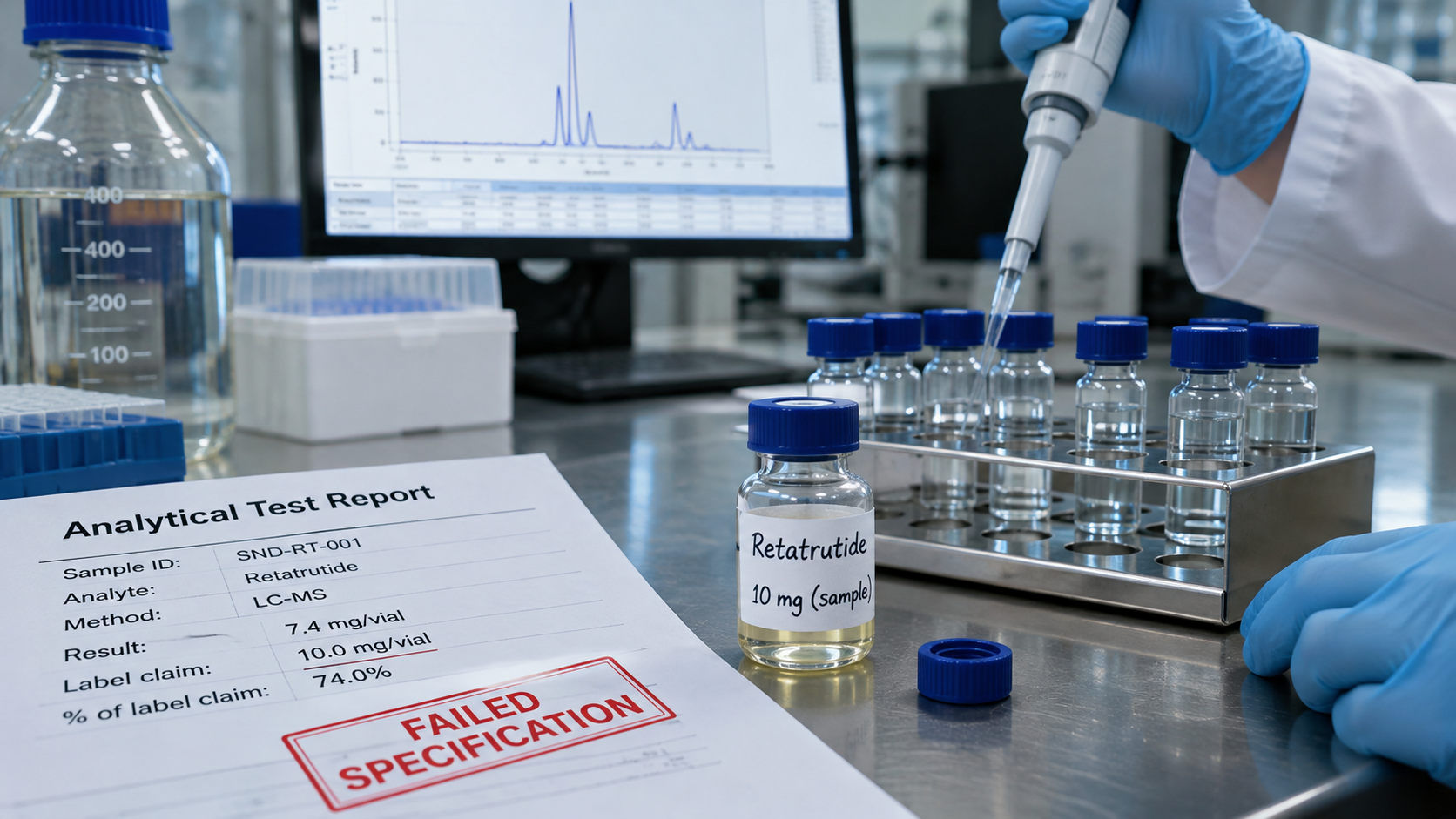
- Tested Synedica Retatrutide 10 mg products contained less retatrutide than claimed, with substantial variation between samples.
- The products were identified during an investigation involving the New South Wales Police State Crime Command.
- The TGA advises consumers not to use Synedica-branded peptide products and to take remaining supplies to a pharmacy for safe disposal.
- Retatrutide remains an investigational medicine and is not approved for general clinical use in Australia or by comparable international regulators.
Australia’s medicines regulator has warned consumers not to use Synedica-branded peptide products after laboratory testing found that several products did not contain the ingredients or amounts stated on their labels.
In a safety advisory published on 5 November 2026, the Therapeutic Goods Administration (TGA) reported that three tested product types contained no detectable TB-500 despite being labelled as containing it.
Separately, tested Synedica Retatrutide 10 mg products contained less retatrutide than the stated amount, with significant variation between samples.
The findings raise immediate safety concerns for people purchasing experimental weight-loss peptides and other unapproved injectable substances through online sellers, social media or informal distribution channels.
Which Synedica products failed TGA laboratory testing?
The TGA identified four product types with discrepancies between their labels and laboratory findings.
| Product | What the TGA found |
|---|---|
| Synedica BPC 157 & TB 500 10 mg | No detectable TB-500 |
| Synedica KLOW 80 mg | No detectable TB-500 |
| Synedica BARBIE KLOW 100 mg | No detectable TB-500 |
| Synedica Retatrutide 10 mg | Less retatrutide than labelled, with significant variation between samples |
KLOW is marketed as a combination containing GHK-Cu, BPC-157, TB-500, KPV and vitamin B12. BARBIE KLOW is labelled as containing these ingredients alongside melanotan I.
The TGA did not establish in its public advisory that every ingredient in these combination products was absent. Its specific published finding was that TB-500 was not detected in the tested samples.
Similarly, the regulator did not publish a precise percentage shortfall for the tested Synedica retatrutide products. It reported that they contained less than the claimed amount and varied significantly between samples.
These distinctions matter: the findings establish serious labelling discrepancies in the tested products, but should not be presented as proof that every peptide product on the market has the same problem.
Why is the retatrutide finding particularly concerning?
Retatrutide has attracted considerable interest because clinical trials suggest it may produce substantial weight loss.
Unlike established GLP-1 medicines such as semaglutide and tirzepatide, however, retatrutide remains investigational.
It acts on three hormone-receptor pathways: GLP-1, GIP and glucagon. Researchers are investigating whether this combination can improve weight management and related metabolic outcomes.
Promising clinical trial results do not make a medicine commercially approved or establish that products sold by unauthorised suppliers are safe.
The TGA states that retatrutide has not been approved by Australia or comparable international regulators. Products marketed as retatrutide outside legitimate clinical trials may be counterfeit or otherwise unreliable.
The latest Synedica findings demonstrate one specific danger: even when a product contains some retatrutide, the amount may not match its label.
For an injectable experimental substance, uncertain ingredient quantities make it impossible for consumers to rely on the label when assessing what they are receiving.
What are TB-500 and BPC-157?
TB-500 and BPC-157 are peptides commonly promoted online for injury recovery, tissue repair and other purported health benefits.
These products are sometimes marketed to athletes, gym users and people seeking faster recovery from musculoskeletal injuries.
However, claims made in online advertising often extend beyond the available human clinical evidence.
TB-500 is associated with thymosin beta-4-related peptide products. Its use in unapproved commercial injections should not be confused with an established, regulator-approved treatment for injury recovery.
BPC-157 is an experimental peptide that has generated interest through preclinical research, but evidence from animal studies does not establish safety or effectiveness in humans.
The TGA has specifically warned about the risks of unapproved peptide products, including BPC-157 and TB-500.
These concerns are not limited to whether an ingredient has a plausible biological mechanism. Manufacturing quality, sterility, purity, dosage consistency and reliable product identification are also essential to medicine safety.
What health risks does the TGA identify?
The regulator warns that unapproved peptides can expose consumers to serious health risks, particularly when products are injected.
Potential concerns include:
- Incorrect ingredient amounts: the labelled dose may not match the substance present.
- Undisclosed ingredients: products may contain substances that consumers do not know they are taking.
- Severe allergic reactions: including potentially life-threatening anaphylaxis.
- Contamination or poor manufacturing quality: products may not meet the standards required of approved medicines.
- Unpredictable effects: particularly when experimental peptides are combined with other substances or medications.
The TGA and Australia’s Chief Medical Officer have previously warned that serious adverse effects associated with unapproved peptides have included liver damage, severe allergic reactions requiring hospitalisation and other complications.
The latest advisory reinforces those broader warnings with laboratory evidence showing that some tested products were incorrectly labelled.
Australia previously found semaglutide in a product sold as retatrutide
The November findings follow another significant Australian retatrutide safety alert.
On 14 September 2026, the TGA reported testing a product marketed as retatrutide after receiving a report of a serious adverse event.
The consumer experienced uncontrollable vomiting that resulted in a torn oesophagus and required hospital treatment.
Laboratory analysis of the investigated product found no retatrutide. Instead, it contained undeclared semaglutide at a concentration approximately eight times higher than the level found in TGA-assessed semaglutide products.
That earlier investigation involved a separate product and should not be confused with the new Synedica testing.
Together, the two regulatory alerts illustrate different ways that unapproved peptide products can be unreliable: a product may contain the wrong active substance, or it may contain less of the advertised substance than claimed.
What should people do if they have purchased Synedica peptides?
The TGA’s advice is explicit: do not use Synedica-branded peptide products.
Consumers who have purchased these products should:
- Stop using them.
- Take any remaining product to a local pharmacy for safe disposal.
- Speak with a healthcare professional if they have already used a product and are concerned about their health.
- Report suspected side effects or other adverse events to the TGA.
Anyone experiencing symptoms of a severe allergic reaction, breathing difficulty or another medical emergency should seek urgent medical assistance.
Consumers should not attempt to compensate for suspected understrength products by increasing the amount injected. The actual contents and concentration may be uncertain.
Australian consumers can report suspected medicine problems through the TGA’s medicine safety reporting channels.
How were the products identified?
The TGA says the products were identified while assisting the New South Wales Police State Crime Command with Strike Force Antree.
The police investigation remains ongoing.
The regulator has also expanded its compliance priorities to include unapproved peptide products following increased detection of unlawful importation, advertising and supply.
The TGA has warned that breaches of Australian therapeutic goods legislation can result in enforcement measures, including financial penalties and criminal prosecution where applicable.
The November advisory does not establish the final outcome of the police investigation or any criminal liability.
Why buying experimental peptides online is particularly risky
Online peptide sellers may use scientific terminology, laboratory-style packaging and claims about purity or research-grade manufacturing to make products appear credible.
However, such claims are not equivalent to independent regulatory assessment.
A product advertised as being for research use may still pose substantial risks if it is supplied or used for human administration.
For prescription medicines, legitimate pharmacy channels provide safeguards involving authorised products, appropriate prescribing and regulated distribution.
Unapproved peptide sellers may operate outside those safeguards.
Consumers researching medicine purchases can consult MediSearcher’s guide to verifying a legitimate online pharmacy.
Even a professional-looking website, a laboratory certificate displayed by a seller or a claim that a product is widely used does not establish that the medicine is approved, genuine or suitable for human use.
Does this warning affect approved GLP-1 weight-loss medicines?
The Synedica advisory concerns specific unapproved peptide products. It is not a finding that authorised semaglutide or tirzepatide medicines are incorrectly labelled.
Approved GLP-1 treatments undergo regulatory assessment for quality, safety and effectiveness and are supplied through regulated pharmaceutical channels.
Patients should not discontinue properly prescribed, approved medicines because of this alert.
For readers comparing established treatments, MediSearcher’s Ozempic vs Wegovy comparison explains important differences between those semaglutide products.
Retatrutide is a different medicine still undergoing clinical development, and consumers should not regard products sold under its name online as equivalent to authorised weight-loss treatments.
What happens next?
The TGA says it will continue working with law-enforcement agencies and other partners to identify and disrupt unlawful peptide supply.
Further regulatory action or police developments may follow, but no specific outcome should be assumed while investigations remain active.
The findings also highlight a broader issue for consumers internationally: rapid interest in experimental medicines can create demand before products have completed clinical trials and regulatory assessment.
For Australians, the immediate message is straightforward. The regulator has identified specific Synedica products with unreliable labelling and is advising consumers not to use them.
For patients interested in future weight-loss treatments, the safer distinction is between medicines being investigated in properly supervised clinical trials and unapproved products offered through commercial peptide sellers.
Reviewed by: Dr Mattias Hagman, PhD
Editorial review: This article was prepared for editorial review of the TGA’s 5 November 2026 laboratory findings, the distinction between confirmed product discrepancies and broader peptide safety risks, retatrutide’s investigational status, and official consumer safety recommendations.
Last reviewed: 6 November 2026
Sources and verification
MediSearcher reviewed the following primary regulatory sources when preparing this article:
- Therapeutic Goods Administration, 5 November 2026: TGA testing finds unapproved peptides do not contain what their labels claim.
- Therapeutic Goods Administration, 14 September 2026: TGA tests counterfeit retatrutide product following serious adverse event report.
- TGA and Australian Chief Medical Officer, 19 June 2026: Concerns regarding the public health risks associated with unapproved peptide products.
- Therapeutic Goods Administration, 17 August 2026: TGA flexes its muscle against illegal peptides and steroids.
- Therapeutic Goods Administration: Peptide products — regulatory information and safety alerts.
Medical disclaimer: This article is for general information only and does not constitute medical advice. Experimental peptides and unapproved medicines can pose serious health risks. Do not use products identified in the TGA warning. Seek advice from a qualified healthcare professional if you have used a potentially unsafe product or have concerns about symptoms. In a medical emergency, seek immediate assistance.