
Equipment comparisons · US
Affiliate disclosure: MediSearcher has affiliate relationships with some suppliers and may earn a commission from qualifying purchases through approved links. Product selection is based on suitability and evidence, not commission.
A portable insulin refrigerator is worth investigating when your medicine needs refrigerated transport and you can support the equipment throughout the journey. The important question is whether the complete setup meets the required conditions, including the periods when an outlet disappears.
Start with the storage requirement
Check that the chosen powered mode provides refrigeration, not only heat protection. Voyager’s manufacturer states 35.6–46.4°F (2–8°C) operation with continuous external power at ambient temperatures no higher than 95°F (35°C). Explorer’s USB-only mode is not equivalent refrigeration. Plan power interruptions, medicine fit and a backup before choosing either design.
The shortlist
Compare by what you need
| Product | Use case | Essential specification | Trade-off | Offers |
|---|---|---|---|---|
4AllFamily VoyagerPowered refrigeration | Repeated refrigerated travel with reliable power | 35.6–46.4°F (2–8°C)Continuous power; ambient ≤95°F (35°C) | Plan for every power interruption |  Compare details ↓ |
4AllFamily ExplorerRefrigeration with Biogel | A pack-based setup with optional USB assistance | Mode dependentUSB alone provides heat protection | Refrigeration requires the Biogel pack | Compare details ↓ |
4AllFamily Nomad BigPassive refrigeration | More usable space in a power-free setup | 35.6–46.4°F (2–8°C)Up to 33h at 86°F (30°C) ambient | Larger format than Medium | Compare details ↓ |
Products & merchants
The details that change the decision
Compare cooling method, preparation and usable space.
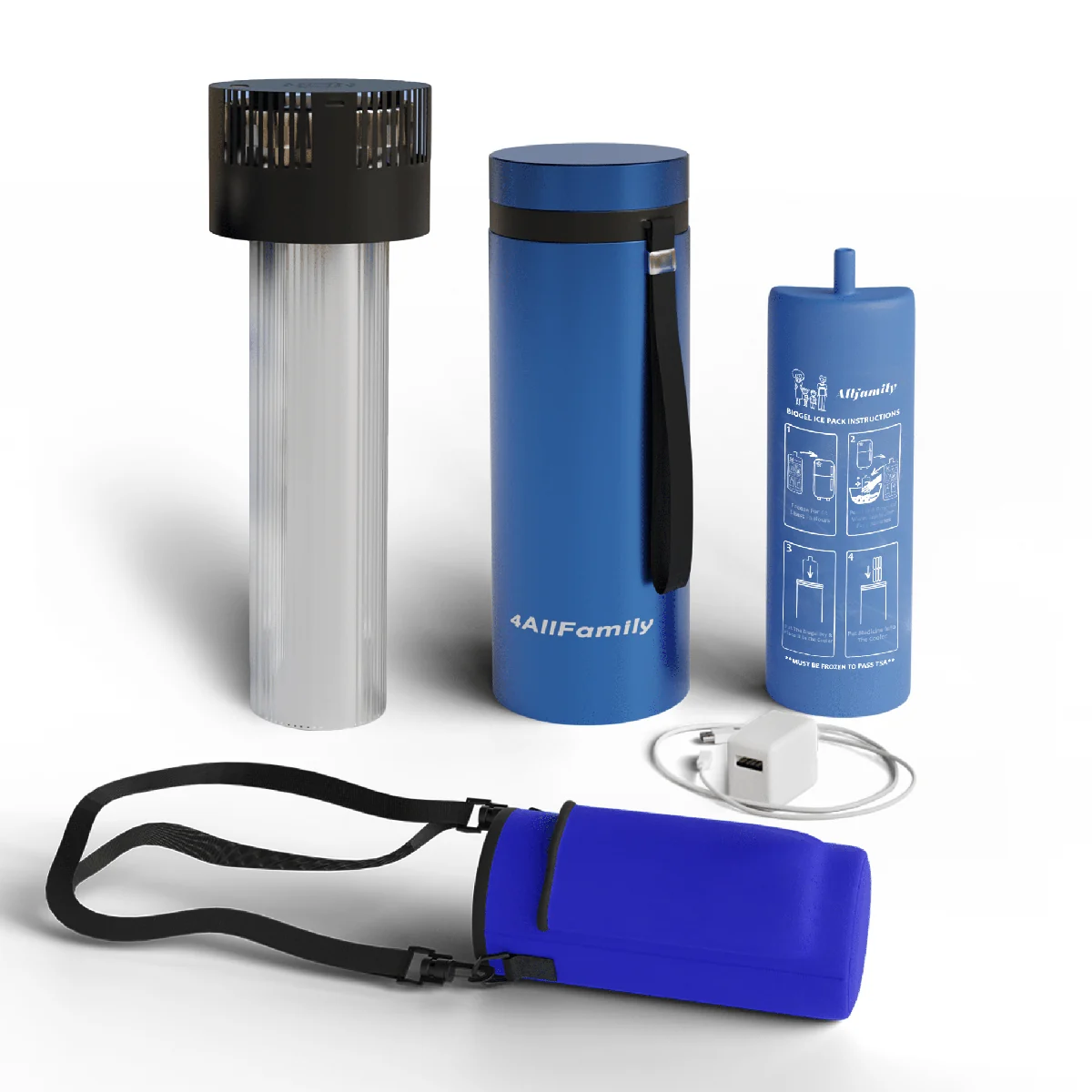
4AllFamily Voyager
Repeated refrigerated travel with reliable power
- Cooling
- 35.6–46.4°F (2–8°C)
- Power / preparation
- External USB; no built-in battery
- Key condition
- Continuous power; ambient ≤95°F (35°C)
Plan for every power interruption
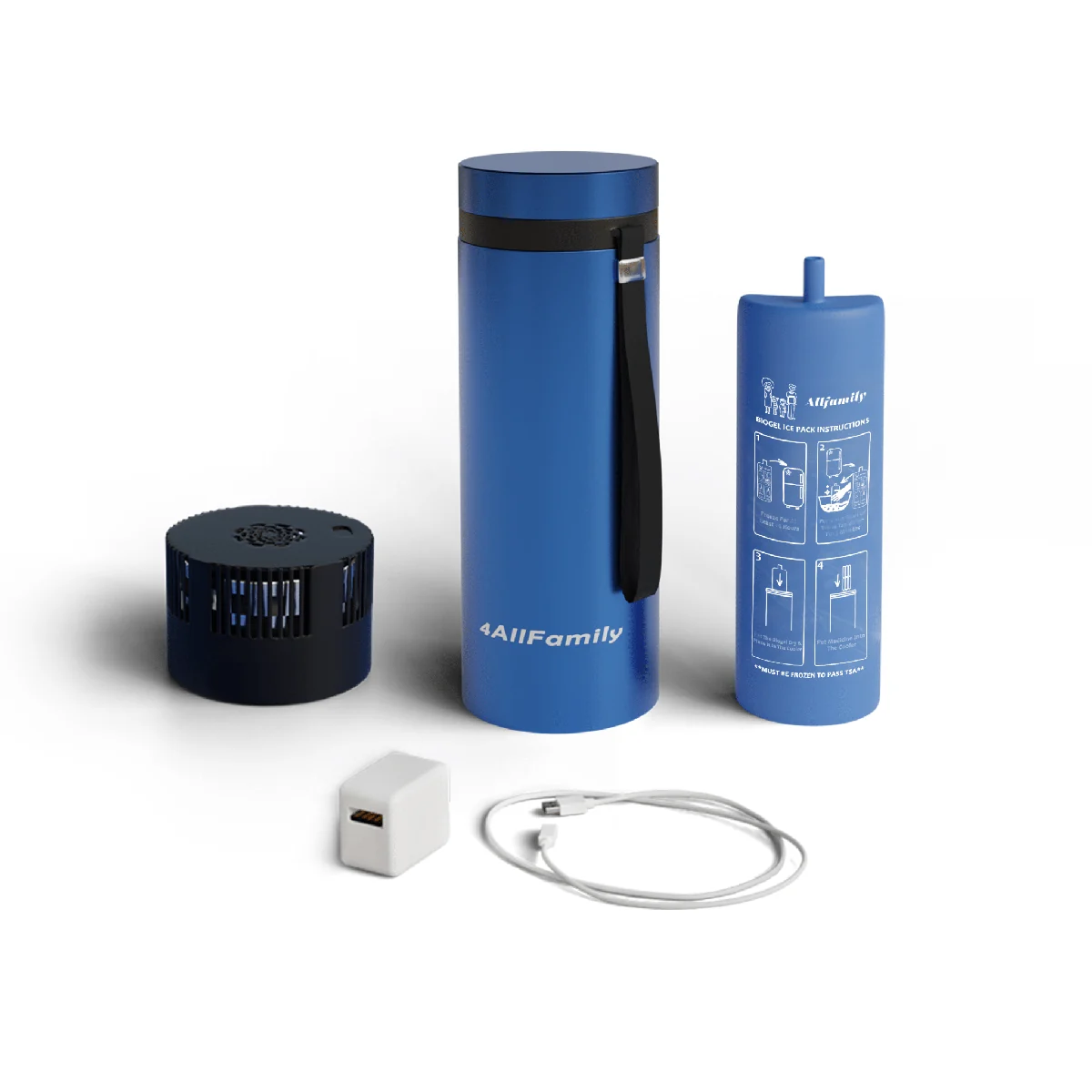
4AllFamily Explorer
A pack-based setup with optional USB assistance
- Cooling
- Mode dependent
- Power / preparation
- Biogel + optional USB
- Key condition
- USB alone provides heat protection
Refrigeration requires the Biogel pack
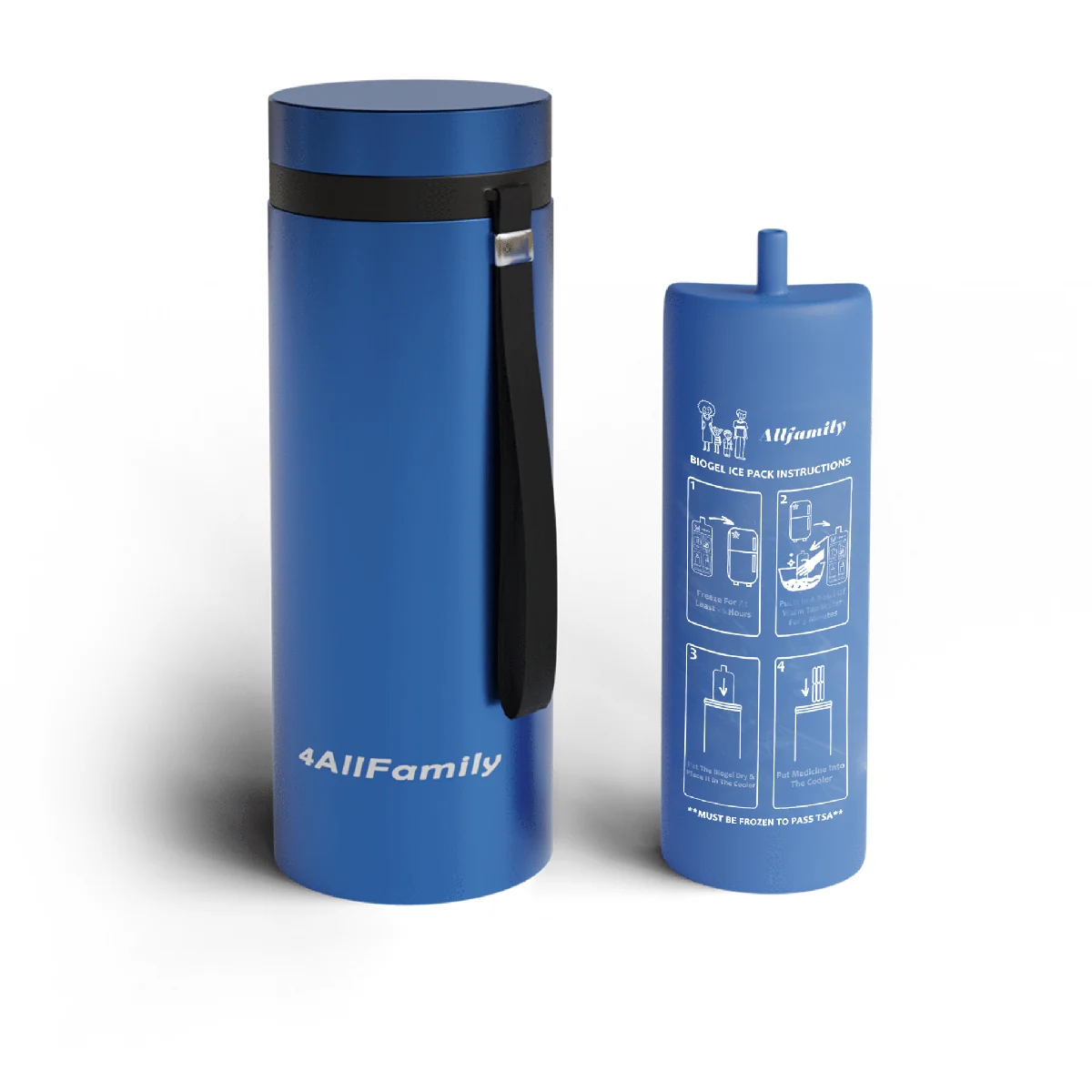
4AllFamily Nomad Big
More usable space in a power-free setup
- Cooling
- 35.6–46.4°F (2–8°C)
- Power / preparation
- Biogel pack
- Key condition
- Up to 33h at 86°F (30°C) ambient
Larger format than Medium
An electric cooler is not automatically a refrigerator
Electricity can support different functions: moving air, assisting a cooling pack or maintaining a specified refrigerated range. A USB connection alone tells you little about which function a product provides. The useful specification names the operating mode, temperature range and outside conditions together.
This distinction also prevents an expensive category mistake. If your medicine only needs protection within its permitted room-temperature conditions, you may not need a refrigerator. If you do need refrigeration, an ordinary cosmetic or drinks mini fridge should not be assumed suitable because it appears in the same shopping results. Look for documentation that answers your medicine-storage requirement.
Voyager and Explorer solve different power problems
| Design | Refrigeration question | Planning consequence |
|---|---|---|
| Voyager | The manufacturer documents powered refrigeration within an ambient limit | Provide suitable continuous external power and a fallback |
| Explorer | Refrigeration uses its Biogel pack, with or without USB assistance | Treat pack preparation and endurance as part of the refrigerated plan |
| Passive case | There is no powered mode to renew cooling during travel | Confirm documented coverage and access to reconditioning facilities |
Voyager does not have a built-in battery. A separate power bank is a separate part of the system, not a hidden feature included by the phrase “portable refrigerator.” See the Voyager documentation and Explorer mode descriptions. Neither specification removes the need to confirm fit and permitted medicine storage.
Make a power inventory before you buy
- Required input and the cable supplied with the exact model.
- Compatible wall adapter and its destination input rating.
- Vehicle power arrangement, including whether the outlet remains powered when the engine stops.
- Airline rules for carrying and using the chosen power bank.
- The longest expected period without a reliable source of power.
Do not infer runtime from a power bank’s marketing capacity alone. Compatibility, conversion losses, conditions and the equipment’s demand matter. Ask the manufacturer for model-specific advice rather than treating an unverified capacity number as guaranteed cooling time. No universal power-bank runtime is claimed in this guide.
Check the cooling environment, not only the set temperature
A refrigerator operates in an environment. Think about where it will sit, how its vents remain clear according to the instructions and whether its surroundings stay within the stated operating conditions. A unit in a closed, sun-heated vehicle is a different proposal from the same unit in a suitable occupied cabin.
A display is useful for observation, but is not necessarily a recording thermometer. Find out what it measures and whether it retains a history. If a history is important to your plan, check that feature explicitly instead of assuming a digital screen provides it. Ask the medicine supplier how to respond to readings outside the required conditions.
Test a complete packing arrangement
Choose the exact medicines and packaging first. Usable chamber dimensions with cooling components installed matter more than external dimensions. Check whether the required carton can remain intact and whether you can remove a pen without compressing others. A large capacity in small insulin pens is not a capacity guarantee for larger injectors.
Practise with the intended cable and power source before travel. Observe ordinary operation as the instructions direct and rehearse a switch to the approved backup arrangement. A home check helps identify connection and packing problems. It does not certify performance for every possible temperature or establish whether medicine exposed during a failed trip is usable.
When a passive case may be easier
A passive system may be simpler when access to electricity is uncertain but suitable preparation is available. A powered system may be easier to maintain during repeated journeys where reliable power is available. Compare the whole routine: carrying weight, reconditioning, changing locations and the return journey. A premium purchase should solve those constraints rather than add new ones.
Use the cooling-case comparison for the broader shortlist, the long-flight guide for airport transfers, and the car-travel guide for stops and power interruption.
Frequently asked questions
Can Voyager operate electrically without being plugged in?
Its electric lid needs external power. The documented product does not include a built-in battery. Its passive cooling arrangement is a separate operating method.
Does Explorer’s USB mode provide the same refrigeration?
No. The manufacturer describes USB-only use as heat protection. Its refrigerated arrangement involves the Biogel pack.
Should I buy a normal mini fridge for medication travel?
Do not assume it is appropriate. Compare documented control, operating limits, usable space and the medicine’s instructions before using any appliance for that purpose.
Sources & selection method
We compare documented functions and practical trade-offs using the sources below. This is desk research, not hands-on testing. Manufacturer performance claims apply under their stated conditions. Product-research snapshot: 5 November 2026. Prices are item-only; shipping and taxes are additional.
Sources and product documentation
- 4AllFamily Voyager specifications — manufacturer
- 4AllFamily Explorer modes — manufacturer
This guide provides general equipment information, not personalised medical advice. Follow the current instructions for your exact medicine and device. Ask your pharmacist, care team or manufacturer about uncertain compatibility or storage exposure.
Editorial reviewer: Dr Mattias Hagman
MediSearcher maintains editorial oversight of its accessories guides, including product suitability, manufacturer instructions and practical safety considerations. Commercial relationships are assessed separately from editorial recommendations.