
Practical guidance · US
Affiliate disclosure: MediSearcher has affiliate relationships with some suppliers and may earn a commission from qualifying purchases through approved links. Product selection is based on suitability and evidence, not commission.
The difficult part of a car journey is often the stop. A setup can work during a drive and still fail the plan when the engine is off, the outlet stops supplying power or the medicine is left in a sun-heated vehicle. Choose a case for that complete pattern.
Before you start
Keep insulin with you in appropriate conditions and plan stops as carefully as driving. Compare a prepared passive system with a powered refrigerator supported by a suitable vehicle supply and fallback. Do not treat a cooling claim at a stated ambient temperature as permission to leave insulin in a parked car.
Draw the route around interruptions
List the longest drive, planned stops, overnight breaks and suitable destination storage. Ask what happens to the medicine at each stop: who carries it, where it stays and whether the cooling method continues to work. Include an unexpected delay or vehicle problem in the discussion with your pharmacist if it could undermine the medicine’s storage requirements.
The key question is not simply whether the case fits a cup holder. It is whether the proposed arrangement remains appropriate while the car is moving, stationary and temporarily unavailable. A neat installation can still be a poor storage plan.
Compare setups for your pattern of travel
| Travel pattern | Approach to investigate | Practical limitation |
|---|---|---|
| Day trip with uncertain vehicle power | Suitable passive cooling or heat protection as the medicine permits | Preparation and coverage must match the route |
| Long drive with reliable external power | Documented powered refrigeration where required | Outlet compatibility and engine-off periods need a plan |
| Multi-day road trip | A maintainable cooling method at every overnight stop | Destination access matters as much as driving time |
| Frequent stops away from the vehicle | A portable arrangement you can take with you | Bulk, carrying convenience and continuity of cooling |
Voyager is a candidate for appropriate powered refrigeration. Nomad is a candidate passive design. Chiller and FRIO belong in heat-protection comparisons where the medicine label permits. Explorer must be assessed by mode. The main case comparison provides the product distinctions; no product here is recommended as a licence for unattended hot-car storage.
Check the actual vehicle connection
Confirm the cooler’s power specification, the intended adapter and the vehicle outlet. Determine whether the outlet remains powered when the ignition is off and whether that behaviour changes after a delay. Follow both the equipment and vehicle instructions rather than assuming every USB port supplies an appropriate output.
Arrange cables so they do not obstruct driving or access to controls. Place equipment securely according to its instructions, with any required ventilation. An unsafe position is not justified by a convenient outlet. Do not handle the kit or adjust a device while driving.
Choose a stop routine before setting off
- Identify who takes responsibility for the medicine when the vehicle stops.
- Keep a suitable carrying arrangement ready so taking it with you is practical.
- Confirm how cooling continues if external power becomes unavailable.
- Keep the leaflet and relevant contacts accessible if a delay creates uncertainty.
- Check the arrangement again before continuing the journey.
CDC specifically advises against storing insulin and other diabetes medicines in a hot car. See its heat guidance. A test at a stated outdoor temperature does not establish what happens in every parked vehicle or in direct sun. Do not extrapolate a published cooling claim beyond its documented conditions.
Plan the overnight and return legs
If the method uses a prepared pack, confirm that you can prepare it again before the next travel day. If it needs power, check the accommodation arrangement and suitable adapter. Keep the return itinerary in the same plan. A cooler that works for the first drive but cannot be maintained during the stay leaves the task unfinished.
Keep medicine and general supplies under their respective instructions. A glovebox or boot is not automatically an appropriate location for a meter or test strips just because they are not the item being refrigerated. The travel essentials checklist can help separate those needs.
Relevant equipment to assess
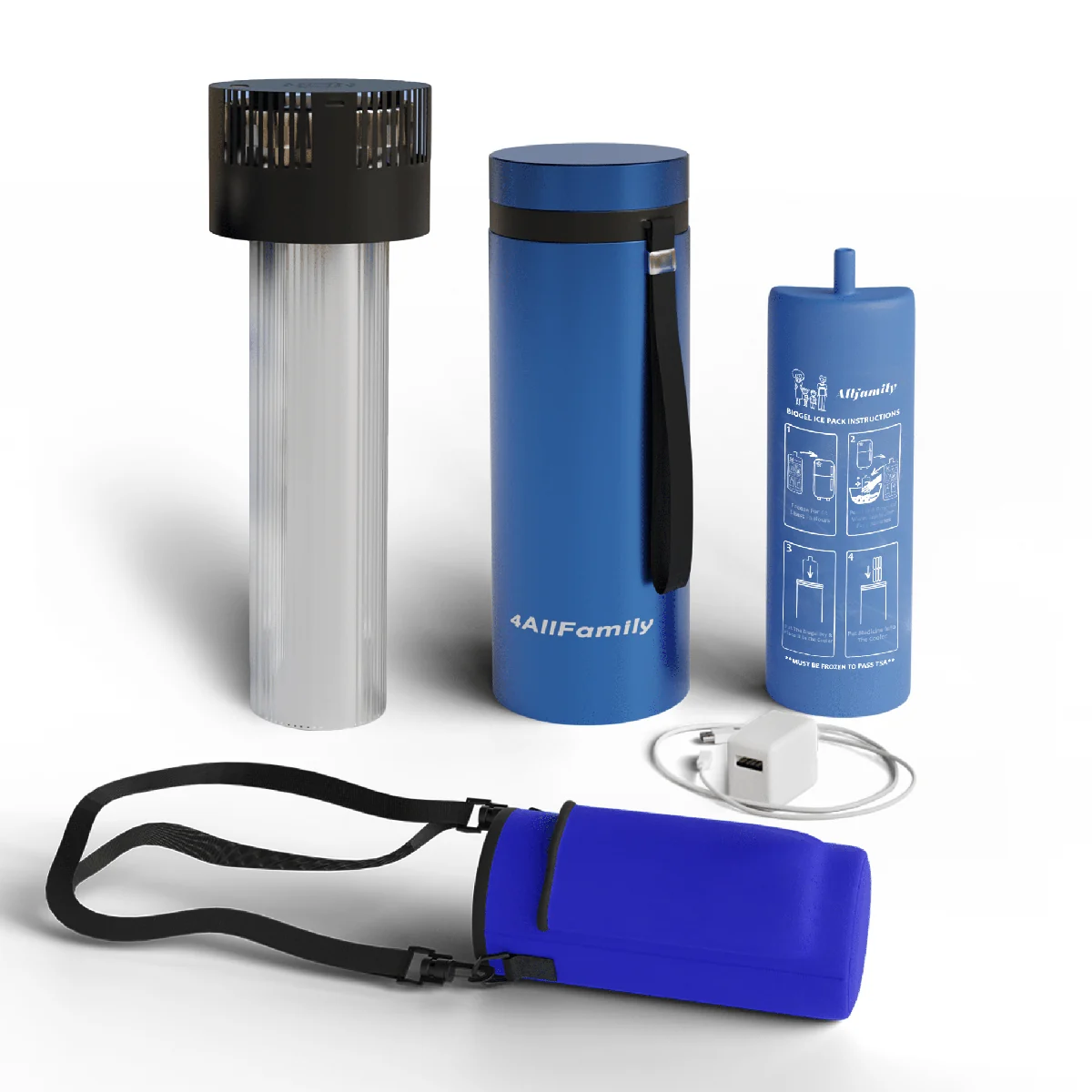
4AllFamily Voyager
Repeated refrigerated travel with reliable power
- Cooling
- 35.6–46.4°F (2–8°C)
- Power / preparation
- External USB; no built-in battery
- Key condition
- Continuous power; ambient ≤95°F (35°C)
Plan for every power interruption
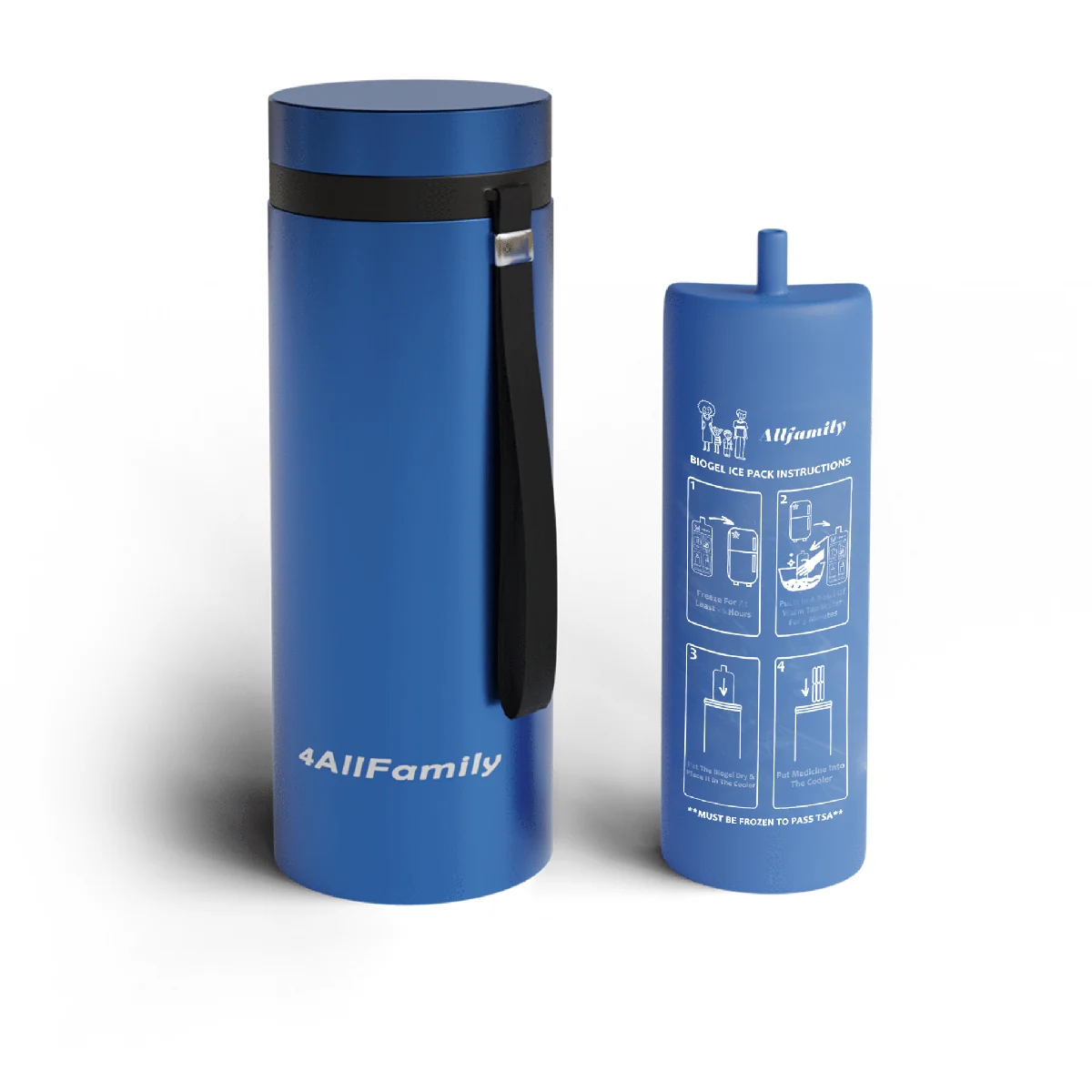
4AllFamily Nomad Big
More usable space in a power-free setup
- Cooling
- 35.6–46.4°F (2–8°C)
- Power / preparation
- Biogel pack
- Key condition
- Up to 33h at 86°F (30°C) ambient
Larger format than Medium
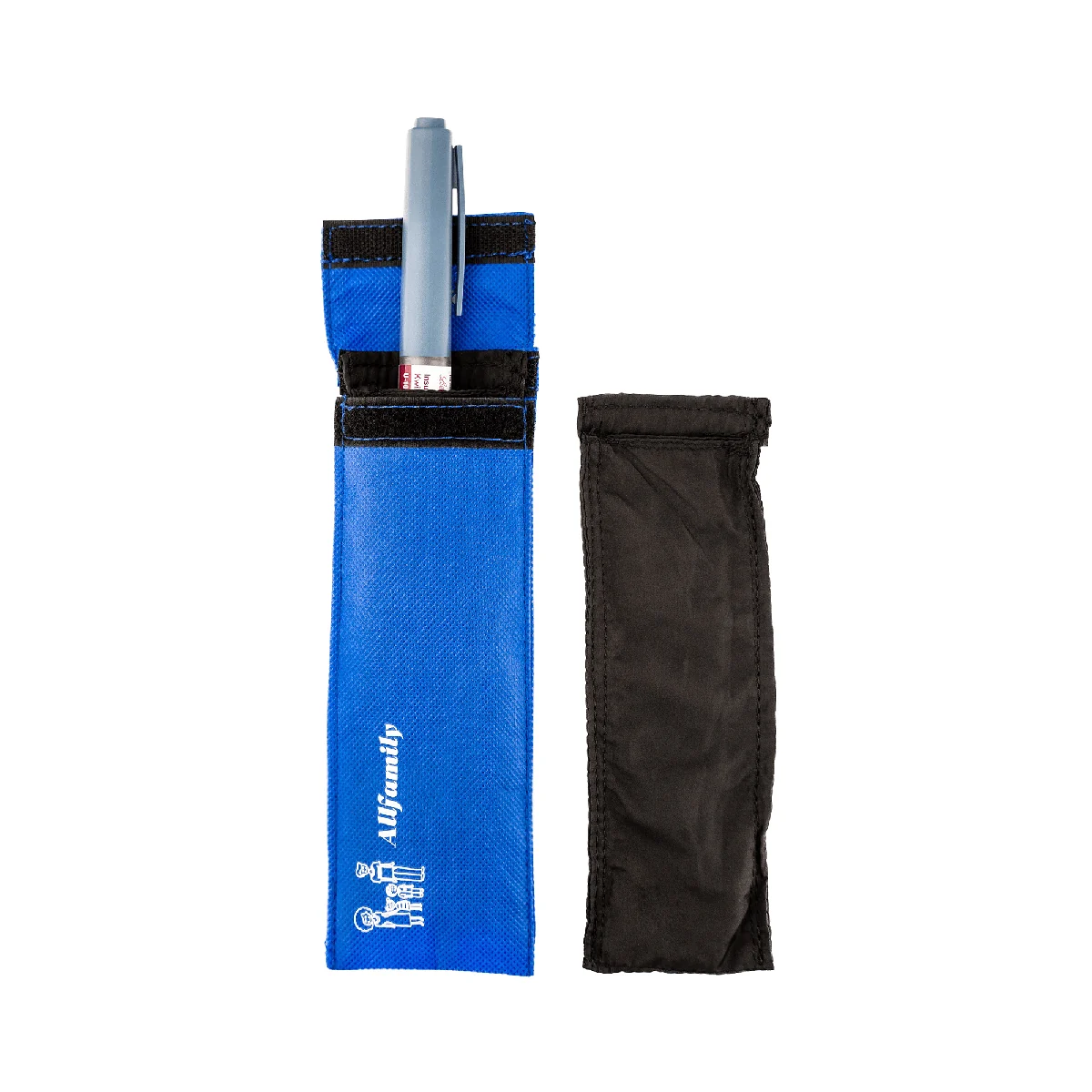
4AllFamily Chiller
A lightweight water-activated approach
- Cooling
- 64.4–78.8°F (18–26°C)
- Power / preparation
- Water activation
- Key condition
- At least 45h at 100.04°F (37.8°C) ambient
Not suitable for a 35.6–46.4°F (2–8°C) requirement
The pictured pouch size is unconfirmed. Choose from the manufacturer’s size guide; this is heat protection, not refrigeration.
 Chiller · choose pouch size

FRIO Duo
Water-activated cooling without a freezer
- Cooling
- 64.4–78.8°F (18–26°C)
- Power / preparation
- Water activation
- Key condition
- 45h at 100.04°F (37.8°C) ambient
Not suitable for a 35.6–46.4°F (2–8°C) requirement
FRIO official instructions
Know what the temperature information can tell you
A current display can show the state at the moment you look. It cannot necessarily show the highest or lowest earlier temperature or how long a threshold was exceeded. Understand whether your chosen equipment records history and how to position and use any sensor according to its instructions.
If you suspect an excursion, note the product, times and available readings and contact the pharmacist or manufacturer for guidance. Do not decide that medicine is usable because the case is cold again. Read the travel storage guide for preparation and the refrigerator guide for power and operating limits.
Frequently asked questions
Can a long-duration cooling case make a parked car safe for insulin?
Do not rely on that assumption. Keep medicine with you in appropriate conditions and follow its instructions. Published performance at one ambient temperature does not cover every vehicle environment.
Will a car USB port keep a refrigerator running during a stop?
Vehicle outlets differ. Check the actual port, adapter, ignition behaviour and cooler requirements, and plan for loss of power.
Is this a different decision from choosing a flight cooler?
Yes. Repeated engine-off stops, vehicle placement, carrying the kit away from the car and overnight reconditioning deserve separate planning.
Sources & selection method
We compare documented functions and practical trade-offs using the sources below. This is desk research, not hands-on testing. Manufacturer performance claims apply under their stated conditions. Product-research snapshot: 5 November 2026. Prices are item-only; shipping and taxes are additional.
Sources and product documentation
- CDC diabetes and heat — public health
This guide provides general equipment information, not personalised medical advice. Follow the current instructions for your exact medicine and device. Ask your pharmacist, care team or manufacturer about uncertain compatibility or storage exposure.
Editorial reviewer: Dr Mattias Hagman
MediSearcher maintains editorial oversight of its accessories guides, including product suitability, manufacturer instructions and practical safety considerations. Commercial relationships are assessed separately from editorial recommendations.