
Practical guidance · US
Affiliate disclosure: MediSearcher has affiliate relationships with some suppliers and may earn a commission from qualifying purchases through approved links. Product selection is based on suitability and evidence, not commission.
The flight time printed on your ticket is only part of the cooling plan. Packing, airport waiting, connections, border checks and the journey to suitable storage can add substantial time. Choose an insulin cooler for that full sequence, using the storage instructions for your particular insulin.
Before you start
Plan door-to-door coverage and a fallback for delays. Compare passive cooling where power is uncertain and powered refrigeration only where a suitable supply is dependable. Keep medicine accessible in your carry-on, check the relevant security rules and confirm airline restrictions for any power bank. An advertised airport-approval badge is not a guarantee of admission.
Count the complete journey
| Illustrative stage | Hours |
|---|---|
| Packing and travel to the departure airport | 2 |
| Check-in and waiting | 3 |
| Flight | 10 |
| Arrival and onward travel | 3 |
| Planned total before additional disruption | 18 |
This is an arithmetic example, not a recommended safety allowance or product performance claim. Replace every number with your own itinerary, then consider disruption. Compare the relevant documented temperature performance with that plan. If the itinerary cannot be covered within the medicine’s instructions and equipment conditions, change the arrangement before departure.
Design around an absent outlet
A seat power symbol is not a dependable storage plan by itself. The outlet may be unavailable, incompatible or restricted for use. Connections and queues create further gaps. A passive case can reduce dependence on cabin power if its documented performance and preparation suit the journey. A powered refrigerator requires a separate answer for each interruption.
Explorer and Voyager should not be treated as interchangeable electric fridges. Check the operating modes in our refrigerator guide. If your plan depends on a specific pack, cable or adapter, identify that component before packing and follow the manufacturer’s method. Do not build a critical plan around an untested substitute.
Medical screening: use the authority for the airport
Check the current official rules for each departure and connection point before traveling. Explain the medical purpose of your supplies at screening and keep the identifying information accessible. A seller’s “TSA-approved” phrase does not decide how an airport applies its procedures. This guide does not promise that every pack condition or container will be accepted.
For UK departures, GOV.UK distinguishes cooling gel packs from ice packs: cooling gel packs are listed as allowed in hand luggage, while passengers are told to contact the airport about ice packs. Ask about the actual equipment you intend to carry rather than using the two terms as though they were always equivalent.
US travellers should consult TSA’s current medical-screening guidance. Check the current rule for the actual pack and airport before departure; frozen and thawed packs should not be treated as interchangeable.
Power banks need a separate airline check
The FAA’s battery guidance places spare lithium batteries and power banks in carry-on baggage, with protection against short circuit. Its standard lithium-ion size limit is 100 Wh, with airline approval applying to certain larger spares. Airlines can impose stricter limits and usage conditions. Read the guidance and your carrier’s current policy for the equipment you intend to use.
Do not confuse permission to carry a power bank with permission to use it throughout the flight. Check the Wh rating on the actual unit, the airline’s handling instructions and how the cooler will be powered during any restriction. Check the chosen battery and cooler combination rather than assuming a runtime.
Keep supplies accessible through transfers
Make a small access plan: which item contains the medicine, where its paperwork is and how you will check the setup without scattering supplies across a security tray or seat. Pack clean supplies and used-sharps equipment in their appropriate separate compartments. If a carry-on is unexpectedly taken for the hold, tell staff about the medicine and remove the items that need to remain with you.
CDC advises that insulin should not be in checked baggage because of possible cold exposure. The broader CDC travel checklist also covers preparation with your care team. Arrange dose timing and time-zone questions with them, rather than taking dosing advice from a cooler comparison.
Relevant equipment to assess
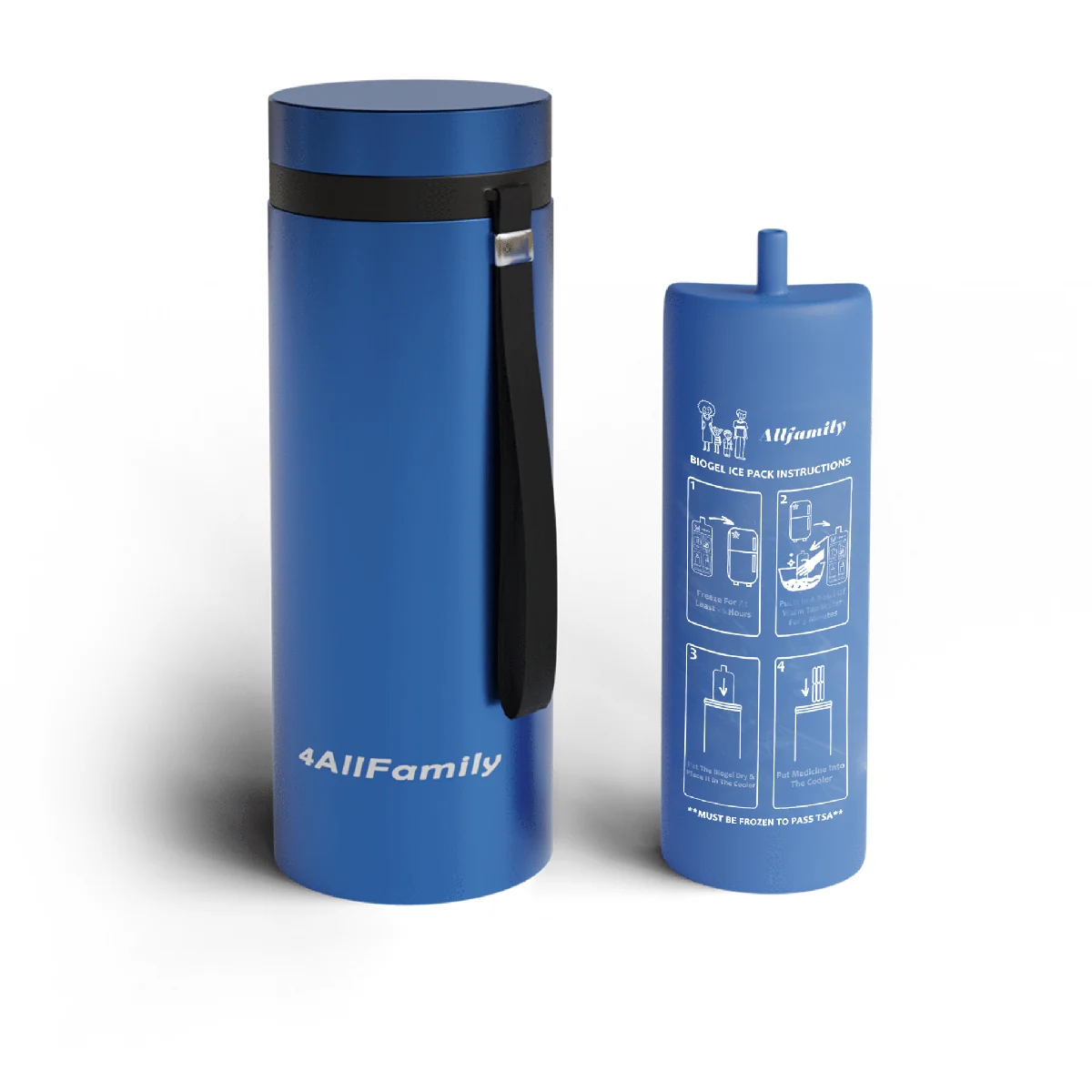
4AllFamily Nomad Big
More usable space in a power-free setup
- Cooling
- 35.6–46.4°F (2–8°C)
- Power / preparation
- Biogel pack
- Key condition
- Up to 33h at 86°F (30°C) ambient
Larger format than Medium

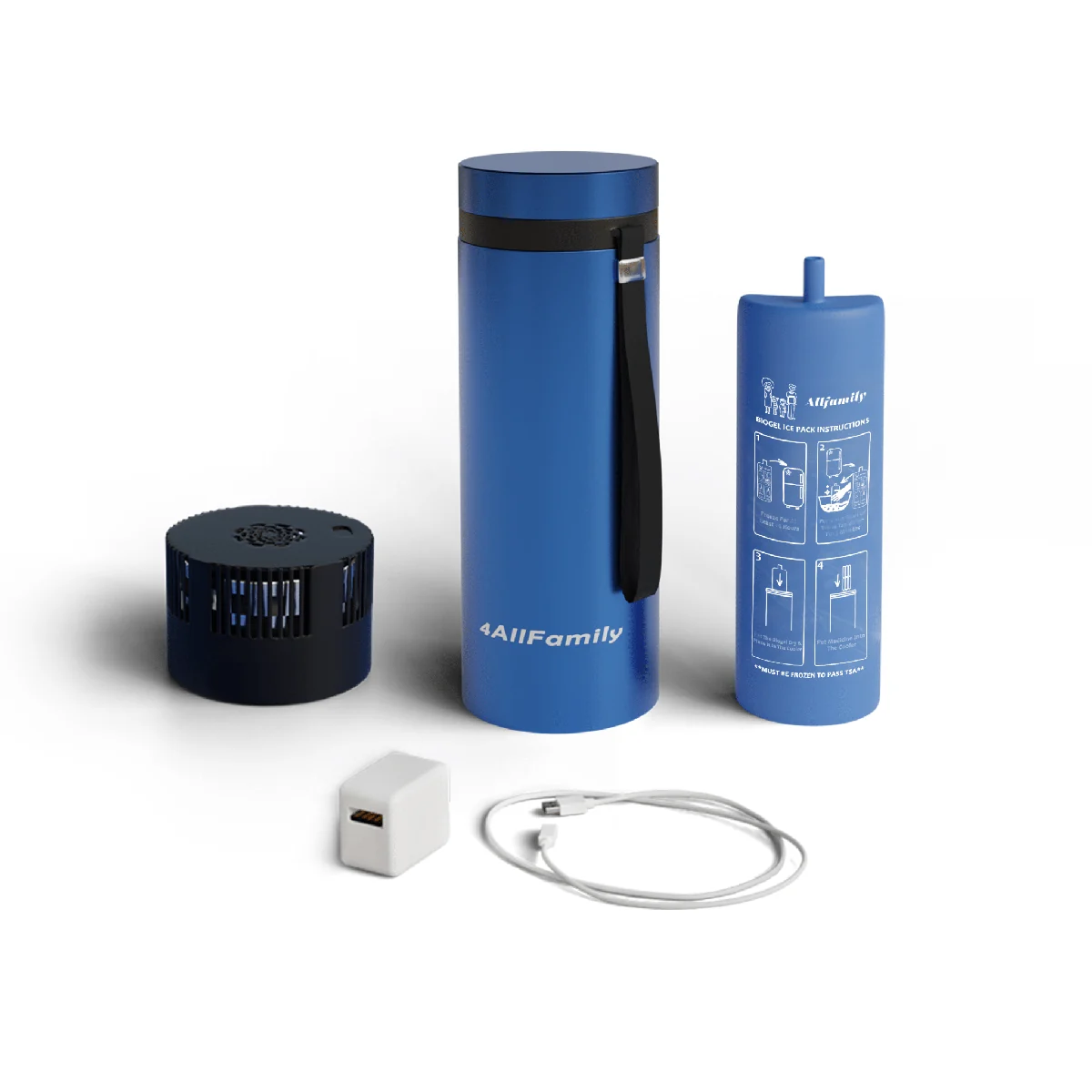
4AllFamily Explorer
A pack-based setup with optional USB assistance
- Cooling
- Mode dependent
- Power / preparation
- Biogel + optional USB
- Key condition
- USB alone provides heat protection
Refrigeration requires the Biogel pack
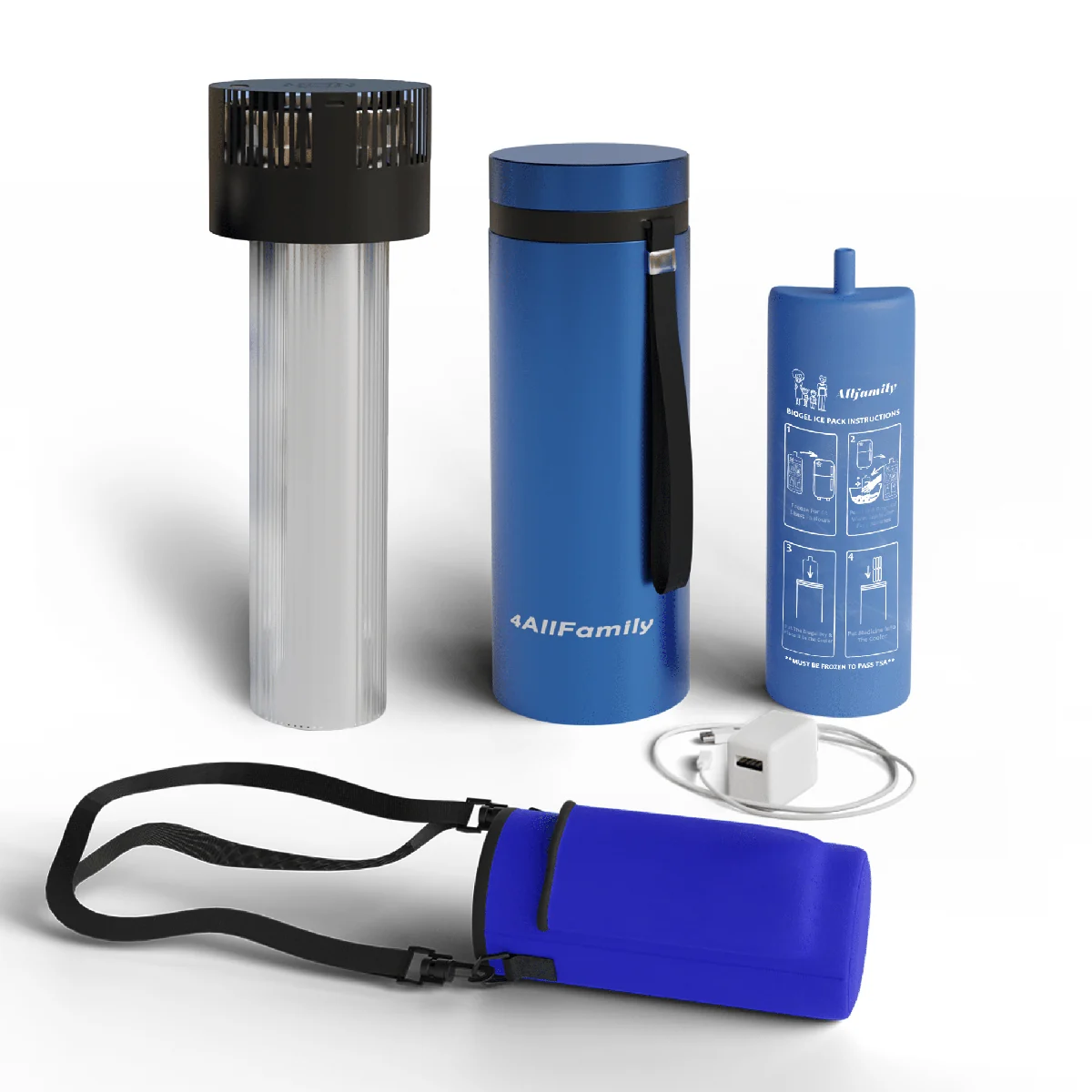
4AllFamily Voyager
Repeated refrigerated travel with reliable power
- Cooling
- 35.6–46.4°F (2–8°C)
- Power / preparation
- External USB; no built-in battery
- Key condition
- Continuous power; ambient ≤95°F (35°C)
Plan for every power interruption
Confirm what happens after landing
Arrange suitable storage before arrival where possible. You may reach accommodation before check-in or travel onward immediately. Ask whether you can access the facilities you need and how you will prepare equipment for the next leg. The return journey deserves the same calculation as the outward one.
Compare designs in the cooling-case guide, follow the sequence in the insulin storage travel guide, and use the essentials checklist for the rest of the kit. If an unplanned exposure occurs, record the details and seek medicine-specific advice before deciding whether the supply remains usable.
Frequently asked questions
Is an airline outlet enough to support a powered fridge plan?
Do not depend on an outlet alone. Account for unavailable power, transfers and any airline restrictions, with a suitable fallback.
Does a TSA-approved product label guarantee airport clearance?
No. Consult the relevant screening authority and airport for the actual supplies and packing arrangement.
Does an eighteen-hour itinerary mean I should buy an eighteen-hour cooler?
Not from that number alone. Check the medicine requirement, the documented temperature conditions and preparation, and plan for disruption beyond the itinerary.
Sources & selection method
We compare documented functions and practical trade-offs using the sources below. This is desk research, not hands-on testing. Manufacturer performance claims apply under their stated conditions. Product-research snapshot: 5 November 2026. Prices are item-only; shipping and taxes are additional.
Sources and product documentation
- FAA PackSafe lithium batteries — aviation authority
- UK medicines and medical equipment in hand luggage — government
- TSA disabilities and medical conditions — aviation authority
- CDC travel with diabetes — public health
This guide provides general equipment information, not personalised medical advice. Follow the current instructions for your exact medicine and device. Ask your pharmacist, care team or manufacturer about uncertain compatibility or storage exposure.
Editorial reviewer: Dr Mattias Hagman
MediSearcher maintains editorial oversight of its accessories guides, including product suitability, manufacturer instructions and practical safety considerations. Commercial relationships are assessed separately from editorial recommendations.