
United Kingdom · Weight-Loss Medicines · 7 October 2026
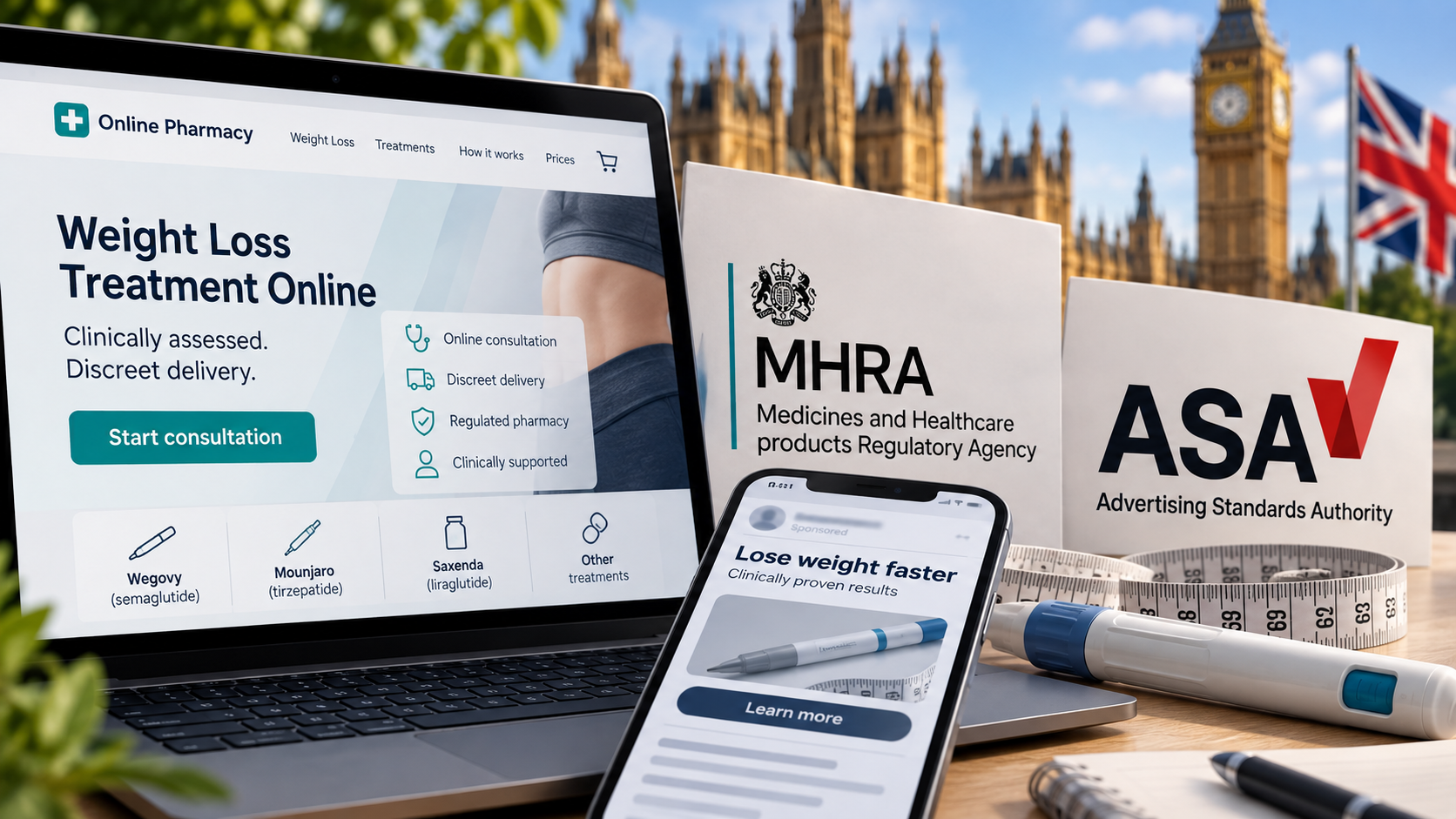
In brief: UK regulators have stepped up enforcement against online advertising for prescription weight-loss medicines, with five new Advertising Standards Authority (ASA) rulings involving online pharmacies and weight-loss services. The action comes just five days after the Medicines and Healthcare products Regulatory Agency (MHRA) announced that nine providers had changed their advertising following a separate enforcement initiative.
UK regulators have stepped up enforcement against online advertising for prescription weight-loss medicines, with five new Advertising Standards Authority (ASA) rulings published on 7 October 2026 involving online pharmacies and weight-loss services.
The rulings concern advertising by Pharmacy Online, Simple Online Pharmacy, MedExpress, Juniper and The Care Pharmacy. In each case, the ASA upheld complaints relating to the promotion of prescription-only medicines (POMs) to the public. Some cases also involved the promotion of weight-loss medicines before they had received UK marketing authorisation.
The action comes just five days after the Medicines and Healthcare products Regulatory Agency (MHRA) announced that nine providers had amended their advertising following separate regulatory action over the promotion of prescription weight-loss medicines.
For patients, the crackdown does not mean that prescription weight-loss medicines such as Wegovy or Mounjaro cannot be obtained through legitimate online pharmacy services.
Instead, regulators are drawing a clearer line between advertising a weight-management or prescribing service, which can be permitted, and advertising prescription medicines themselves to members of the public, which is prohibited.
Five weight-loss advertising rulings published on the same day
On 7 October, the ASA published rulings involving Pharmacy Online, Simple Online Pharmacy, MedExpress, Juniper and The Care Pharmacy.
The advertisements differed considerably, but the ASA concluded that each crossed the line into promoting prescription-only medicines.
Importantly, an advertisement does not necessarily have to mention “Wegovy” or “Mounjaro” by name to breach the rules.
The ASA’s decisions show that regulators can consider the overall impression created by an advertisement — including its wording, imagery, prices, claims about weight loss and appetite, and where consumers are taken after clicking it.
MedExpress: “food noise” and cravings
A Facebook advertisement for MedExpress stated that medicated weight loss could help “silence food noise”, control cravings and help people feel fuller for longer.
MedExpress argued that it offered various weight-loss products and services, including non-prescription options, and that the advertisement promoted its consultation service rather than a particular prescription medicine.
The ASA disagreed.
It concluded that at least a significant minority of consumers would understand claims about reducing food noise, controlling cravings and increasing fullness as referring to prescription weight-loss medicines.
The regulator also examined what happened after users clicked the advertisement. Consumers were ultimately taken to pages showing branded Wegovy and Mounjaro injection pens.
The ASA therefore concluded that the advertising journey promoted prescription-only medicines to the public.
Juniper: prices and weight-loss claims can identify prescription treatment
The Juniper ruling demonstrates how an advertisement can fall foul of the rules without explicitly naming a drug.
Its Google advertisement included references to weight-loss medication from £65, “all doses in stock”, an online consultation and the potential to lose up to 23% of body weight while reducing cravings and regulating appetite.
The ASA considered those elements together.
It concluded that many consumers would associate the combination of the pricing, dosage language, consultation requirement, substantial weight-loss claim and appetite effects with prescription GLP-1 medicines.
Users clicking through the advertisement could also eventually reach pages containing references to injections and an image of a Wegovy pen.
The ASA ruled that the advertisement promoted prescription-only medicines.
Even an injection-pen image can cross the line
The Care Pharmacy case was simpler but illustrates another important point.
A paid Google advertisement displayed a grey pen-shaped medical product next to the words “Weight Loss Solution” and a price of £149.99.
The ASA said its consumer research had found that images of weight-loss injector pens were a strong signal to consumers that an advertisement concerned prescription-only weight-loss medication.
The customer journey also led to a page containing named medicines including Mounjaro, Wegovy, Saxenda, Nevolat and prescription-strength orlistat.
The complaint was upheld.
Oral Wegovy creates a new advertising problem
Two of the latest cases also concern one of the biggest recent changes in UK weight-loss treatment: oral GLP-1 medicines.
The MHRA approved the first GLP-1 receptor agonist tablet for weight management in the UK on 11 June 2026.
The once-daily Wegovy tablet contains semaglutide, the same active ingredient used in injectable Wegovy. It is a prescription-only medicine and is approved for eligible adults with obesity, or certain overweight adults with at least one weight-related health condition.
The approval created a significant new option for people who may prefer a tablet to a weekly injection.
It also created new advertising compliance issues.
Advertising before the medicine was authorised
The ASA found that Pharmacy Online had run an advertisement on 2 June — nine days before the Wegovy tablet received UK authorisation.
The advertisement promoted an upcoming oral weight-management treatment as an alternative to injections and invited people to register for early access.
Because the product was not yet authorised as a medicine in the UK, the ASA concluded that medicinal claims promoting it were not permitted.
After Wegovy tablets were authorised on 11 June, Pharmacy Online’s website subsequently displayed the name Wegovy, an image of a bottle labelled as semaglutide tablets and an invitation to pre-order.
That created a different problem: once authorised, Wegovy became a prescription-only medicine and therefore could not be advertised directly to the general public.
Simple Online Pharmacy also promoted oral GLP-1 treatments
A separate ruling against Simple Online Pharmacy involved advertisements for forthcoming oral weight-management medicines.
One advertisement seen on 1 June promoted a new oral treatment before any oral GLP-1 medicine had been authorised for weight management in the UK.
Its associated landing page referred to both Wegovy tablets containing semaglutide and Foundayo tablets containing orforglipron and included claims about weight loss and appetite.
Oral Wegovy was subsequently authorised on 11 June 2026, while Foundayo was authorised on 10 August.
The ASA concluded that the earlier advertising made medicinal claims for products that had not yet been authorised.
A later advertisement created the opposite regulatory issue: following authorisation, the products were prescription-only medicines and therefore could not be promoted to the public.
Before authorisation, a company cannot promote an unauthorised product as a medicine. After authorisation as a prescription-only medicine, it cannot advertise that medicine to the general public.
MHRA action against nine providers adds to the crackdown
The ASA rulings follow separate action announced by the MHRA on 2 October 2026.
Nine providers amended advertising following MHRA intervention: Pharmacy Online, Mayfair Weight Loss Clinic, Oushk Pharmacy, Peak Pharmacy Chellaston, Birchall & Haydock Pharmacy, The Virtual Slimming Clinic, Simple Online Pharmacy, Curate Health and The Family Chemist.
The affected material included pharmacy websites, emails and posters displayed at pharmacy premises.
The MHRA specifically warned that the prohibition is not limited to advertisements explicitly naming medicines.
Indirect references to concepts such as “weight-loss injections” or “GLP-1 medication” can also amount to promotion where the advertising is likely to lead someone to request a prescription-only medicine.
Can an online pharmacy advertise weight-loss treatment?
Yes — but there is an important distinction.
UK providers can advertise the service or consultation they offer for a medical condition.
That means an online pharmacy can tell consumers that it provides weight-management consultations or treatment services.
What it cannot do is use that advertising to encourage members of the public to obtain a particular prescription-only medicine.
MHRA guidance also distinguishes between promotional pages and more detailed medicine information that a patient actively chooses to access.
For example, a website can provide non-promotional information about individual medicines deeper within the site when it forms part of a fair overview of available treatment options.
The homepage, advertisements and promotional customer journey should instead focus on the medical condition and the service being offered rather than steering patients toward particular prescription medicines.
Can pharmacies advertise Wegovy or Mounjaro to previous customers?
The latest MHRA action also clarifies an issue that may surprise patients who have previously used an online prescribing service.
Being an existing or former customer does not automatically remove someone from the definition of the general public for medicines-advertising purposes.
The MHRA says providers should not send proactive promotional communications, such as emails or text messages, identifying medicines in a way likely to encourage use of a prescription-only drug.
That remains the case simply because someone previously expressed interest in a service or was previously prescribed the medicine.
Can you still get Wegovy or Mounjaro from an online pharmacy?
Yes.
The advertising restrictions should not be confused with restrictions on legitimate prescribing.
Prescription weight-loss medicines can still be supplied through appropriately regulated services when a qualified healthcare professional determines that treatment is suitable for the individual patient.
The important distinction is between access and advertising.
A pharmacy can provide a legitimate online pharmacy and prescribing service. What it cannot do is market prescription-only medicines to the public in the same way a retailer might advertise an ordinary consumer product.
Patients should therefore not interpret the absence of Wegovy, Mounjaro or another medicine from a pharmacy’s advertisements as meaning that the pharmacy does not offer it.
Likewise, prominent advertising of a particular prescription medicine should not be taken as evidence that the medicine is appropriate for the person seeing the advertisement.
Suitability should be determined through an appropriate clinical assessment.
What should patients look for when seeking weight-loss treatment online?
People considering prescription weight-loss treatment online should focus on the provider rather than advertisements promising a particular medicine, price or amount of weight loss.
A legitimate prescribing service should assess whether treatment is medically appropriate before supplying a prescription-only medicine.
Patients should be cautious about services that appear to guarantee access to a particular prescription medicine, minimise the importance of medical assessment, or use highly promotional claims to encourage people toward a specific drug.
Patients should also be aware that medicines offered outside legitimate prescribing and pharmacy channels may not be genuine. In October 2026, UK authorities seized more than 12,000 fake tirzepatide and retatrutide injection pens during an operation in Birmingham, highlighting a separate but related risk from the growing online market for weight-loss medicines.
The latest ASA decisions also demonstrate why an advertisement should not be treated as medical advice.
Whether Wegovy, Mounjaro or another weight-management treatment is appropriate depends on factors including a person’s health, weight, other medicines and potential contraindications.
What happens next?
The five ASA rulings published on 7 October are part of a broader enforcement programme rather than isolated cases.
Combined with the MHRA’s action against nine providers announced on 2 October, they show that UK regulators are scrutinising not only explicit advertisements naming Wegovy or Mounjaro but also more subtle advertising signals.
References to injections, GLP-1 medicines, appetite suppression, cravings, dramatic weight-loss percentages, dosage availability, medicine-like pricing and even images resembling injection pens can all contribute to an advertisement being interpreted as promotion of a prescription medicine.
For online pharmacies and weight-management providers, that creates a significantly narrower advertising path.
For patients, however, the central message is simpler:
The UK has not banned online access to prescription weight-loss medicines. Regulators are cracking down on how those medicines are marketed to the public.
Reviewed by: Dr Mattias Hagman, PhD
Editorial review: This article was reviewed for source accuracy, regulatory context and consistency with MediSearcher’s editorial standards. Regulatory claims were checked against primary sources from the UK Medicines and Healthcare products Regulatory Agency (MHRA) and Advertising Standards Authority (ASA).
Last reviewed: 9 October 2026
Sources and further reading
- Advertising Standards Authority — Pharmacy Online ruling, 7 October 2026.
- Advertising Standards Authority — Simple Online Pharmacy ruling, 7 October 2026.
- Advertising Standards Authority — MedExpress ruling, 7 October 2026.
- Advertising Standards Authority — Juniper ruling, 7 October 2026.
- Advertising Standards Authority — The Care Pharmacy ruling, 7 October 2026.
- MHRA — Medicinal treatment services for weight loss: September 2026, 2 October 2026.
- MHRA — First GLP-1 tablet for weight loss approved in the UK, 11 June 2026.