
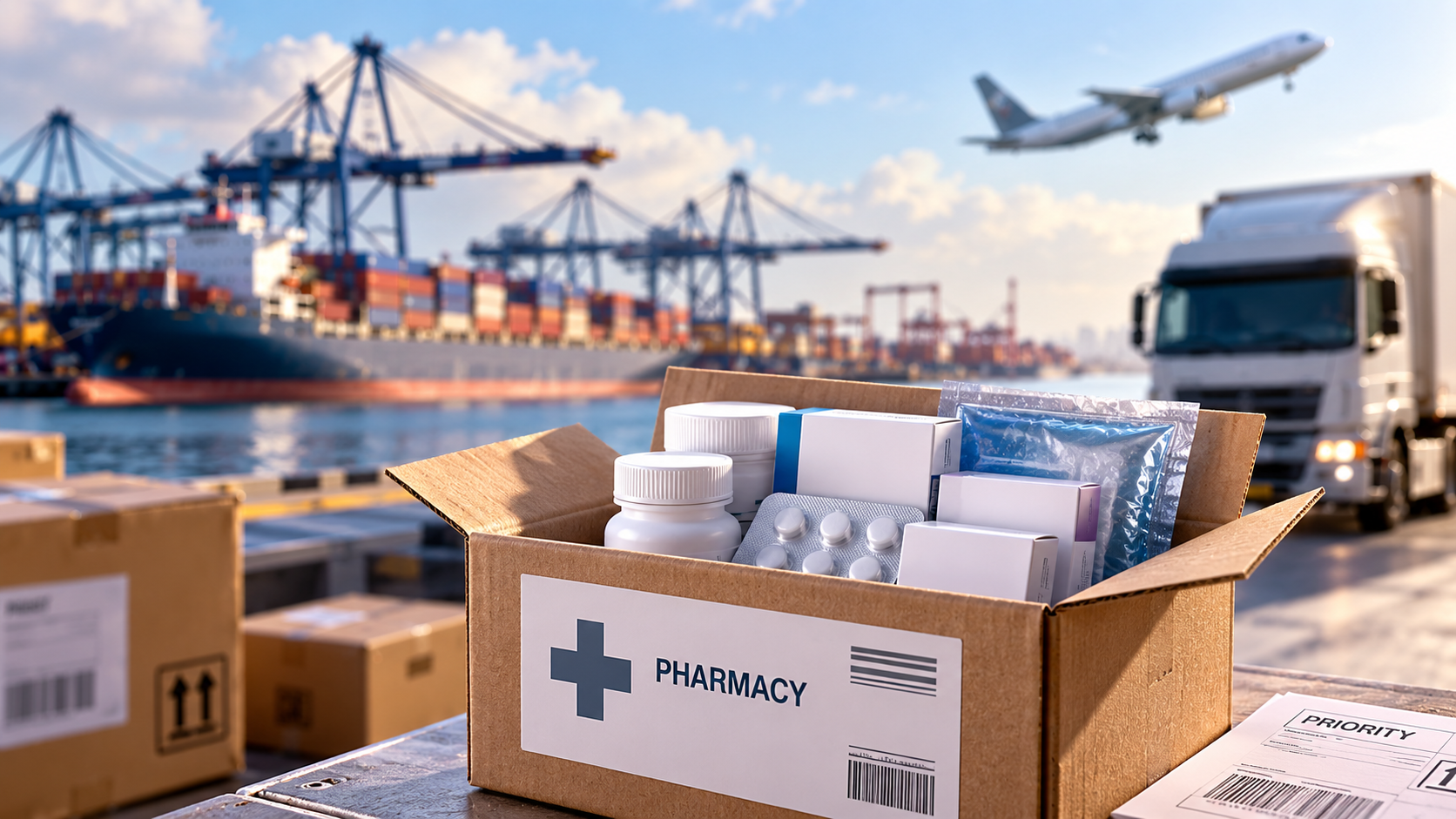
International shipping networks are experiencing significant disruption in October 2026, with port congestion, severe weather, reduced schedule reliability and continuing uncertainty on some major international shipping routes.
This does not mean that all online pharmacies or medication deliveries are currently delayed. However, medicines depend on complex supply chains, and international transport disruption can affect everything from pharmaceutical ingredients and finished medicines to the final delivery of an online pharmacy order.
If you rely on medication delivered by mail, particularly from another country, it may be sensible to allow extra time for delivery and avoid waiting until your current supply is almost exhausted before arranging a refill.
Quick answer: There is clear evidence of wider international shipping disruption in October 2026, including congestion affecting North Europe and Asia-Europe routes. There is not currently evidence of a Europe-wide medication delivery crisis. Patients should distinguish between a delayed parcel and an actual medication shortage.
Reviewed by: Dr Mattias Hagman, PhD
Last updated: October 4, 2026
Are Medication Deliveries Being Delayed in October 2026?
Some international deliveries are currently facing conditions that can increase transit times, but the situation varies significantly by route, country, carrier and supplier.
In its October 2026 freight market update, logistics company C.H. Robinson reported that global port congestion was absorbing approximately 12% of vessel capacity, which it described as a four-year high. The company identified significant effects in East Asia and North Europe and said schedule reliability had fallen as congestion, vessel bunching, typhoons and conditions in the Middle East affected shipping networks.
Maersk has separately reported that severe typhoons in East Asia caused flooding, port congestion and vessel delays, with resulting schedule changes and capacity constraints producing knock-on effects across the wider shipping network, including Europe. The carrier has also reported congestion at key North European and Mediterranean gateways.
Postal and parcel networks can face more specific regional problems. Royal Mail’s international incident bulletin, updated on October 1, 2026, warns that the situation in the Middle East is causing severe delays on some affected international routes and can also affect shipments that transit through the region.
These reports provide good evidence that the international logistics environment is unusually disrupted. They do not, however, establish that every pharmacy, postal service or medication shipment is experiencing delays.
Why Are International Deliveries Taking Longer?
There is no single cause behind the current disruption. Several problems are occurring at the same time.
Port congestion
Congestion reduces the effective capacity of international shipping networks even when ships and containers are technically available. C.H. Robinson’s October update identifies North Europe, East Asia and the Indian Subcontinent among the regions significantly affected by current port congestion.
Severe weather in Asia
East Asia experienced significant typhoon activity during 2026. According to Maersk, several severe typhoons occurring within a short period caused flooding, congestion and vessel delays. Changes to shipping schedules in Asia can subsequently affect European arrivals because vessels, containers and port slots form part of interconnected international networks.
Continuing uncertainty around Red Sea and Suez routes
Some shipping services have begun returning to routes through the Suez Canal, potentially reducing transit times between Asia and Europe. However, shipping companies continue to describe the situation as dependent on security conditions in the Red Sea and Middle East.
This means routing can still differ between carriers and services, and conditions can change relatively quickly.
Industrial action and local transport disruption
Industrial action and operational problems at individual ports can add further delays. Maersk reported in September that industrial action at German terminals had affected connections through Hamburg, Bremerhaven and Wilhelmshaven, while congestion continued at other North European and Mediterranean gateways.
How Can Shipping Disruption Affect Medication Orders?
When an online medication order is late, it is useful to understand that there are several different parts of the supply chain where a delay can occur.
A simplified medication supply chain might look like this:
- Pharmaceutical ingredients and materials are produced.
- The medicine is manufactured and packaged.
- Finished products are transported to wholesalers or distributors.
- The pharmacy receives its stock.
- The pharmacy processes the patient’s prescription or order.
- The parcel is handed to a postal or courier service.
- For international orders, the parcel may pass through international transport hubs and customs.
- A local carrier completes the final delivery.
A problem at any of these stages can potentially affect availability or delivery time.
For example, a pharmacy might have the medicine in stock and dispatch it normally, only for the individual parcel to be delayed during transport. Alternatively, the parcel network may be operating normally while the pharmacy itself is waiting for new stock.
These are different situations and should not automatically be treated as evidence of a medication shortage.
A Shipping Delay Is Not the Same as a Medication Shortage
This distinction is particularly important.
A delivery delay means an individual order or shipment is taking longer than expected to reach its destination. A medication shortage means available supplies of a medicine are insufficient to meet demand in a particular market.
The European Medicines Agency (EMA) identifies numerous potential causes of medicine shortages, including manufacturing problems, shortages of raw materials and active ingredients, global supply-chain disruption, limited production capacity and sudden increases in demand.
Not every current medicine shortage is related to transportation.
For example, there is currently a shortage of Topamax tablets in parts of the EU/EEA that EMA expects to continue until the end of 2026. EMA states that this particular shortage resulted from manufacturing problems, rather than the wider shipping disruption discussed in this article.
If you are concerned about the availability of a specific medication, check with your pharmacy, prescribing healthcare professional or the appropriate national medicines authority rather than assuming that general shipping problems mean the medication itself is in shortage.
What Should You Do If You Order Medication Online?
If you regularly receive prescription medication by mail, a few practical precautions can reduce the risk of being left without medicine because a shipment arrives later than expected.
- Do not leave repeat orders until the last few doses. Where prescription rules allow, arrange your refill with enough time to accommodate a reasonable delivery delay.
- Check both processing and delivery estimates. A pharmacy may require time to verify a prescription and prepare an order before the parcel is handed to the carrier.
- Use tracking when available. Tracking can help distinguish between an order still being processed by the pharmacy and a parcel delayed after dispatch.
- Contact the pharmacy if the expected delivery window has passed. The pharmacy may be able to investigate the shipment or advise whether a replacement is appropriate.
- Do not automatically place duplicate prescription orders. Check the status of the original order first, particularly for prescription-only medicines.
- If you may run out of an important medicine, contact a pharmacist or your prescribing healthcare professional. Do not rely on a delayed shipment arriving at the last moment.
- Do not change your prescribed dose simply to make your supply last longer unless a qualified healthcare professional advises you to do so.
When choosing an online provider, you should also verify that you are dealing with a legitimate pharmacy. See our guide on how to verify a legitimate online pharmacy before ordering prescription medication online.
Be Particularly Careful With Temperature-Sensitive Medicines
Shipping delays can require additional attention when a medication has specific temperature or storage requirements.
This can be relevant to medicines such as insulin and some injectable GLP-1 medications. Storage requirements vary between products and can also differ depending on whether a product is unopened or already in use.
A delayed delivery does not automatically mean that a medication is unsafe to use. Equally, a medicine should not automatically be assumed to be suitable for use if its required storage conditions may have been exceeded.
If a temperature-sensitive medicine arrives substantially later than expected, unusually warm or cold, with damaged packaging, or with compromised temperature-control materials, check the manufacturer’s storage instructions and contact the dispensing pharmacy if you are uncertain about its condition.
Do not use appearance alone to determine whether a temperature-sensitive medication has remained within its required storage conditions.
Domestic vs International Pharmacy Deliveries
Domestic and international medication deliveries can face different logistical risks.
A domestic order may travel directly from a pharmacy or fulfilment centre through a national courier network. An international order can involve additional transport stages, carrier handovers, international sorting facilities and customs processing before reaching the local delivery network.
This does not mean international pharmacy orders are inherently unreliable. However, additional stages create more points at which a delay can potentially occur, particularly during periods of wider international transport disruption.
Before ordering from another country, check where the pharmacy actually dispatches its medicines from rather than relying solely on the location of the website or company.
How to Tell Where Your Medication Order Is Delayed
The status shown by the pharmacy or carrier can provide clues about where a problem has occurred.
- Order received: The pharmacy has received your order but may not yet have processed the prescription.
- Processing or prescription review: The pharmacy may still be verifying the prescription, payment, stock or patient information.
- Dispatched or shipped: A shipping label may have been created, but this does not always mean the parcel has begun moving through the carrier’s network.
- Carrier accepted: The parcel has normally entered the delivery network.
- In transit: The shipment is moving through one or more distribution facilities or transport networks.
- Customs or clearance: International shipments may be waiting for customs or other import processing.
- Out for delivery: The parcel has normally reached the final local delivery stage.
If tracking has not changed for an unusually long period, contact the pharmacy or carrier rather than assuming that the medication itself is unavailable.
Current Shipping Situation: October 2026
Situation checked: October 4, 2026.
At the time of this update, several indicators point to significant disruption within international freight and parcel networks:
- C.H. Robinson reports that global port congestion is absorbing approximately 12% of vessel capacity, a four-year high, with significant effects in North Europe and East Asia.
- The same October 2026 freight update reports sharply reduced schedule reliability caused by a combination of port congestion, vessel bunching, typhoons and geopolitical and operational disruption.
- Maersk reports that severe typhoons in East Asia have caused congestion and delays whose effects are being felt across the wider shipping network, including Europe.
- Maersk has also reported congestion affecting key North European and Mediterranean gateways.
- Royal Mail’s October 1 international service update warns of severe delays affecting some Middle Eastern destinations and shipments transiting through affected areas.
These conditions can affect international deliveries, but they should not be interpreted as evidence that all online pharmacy shipments are delayed or that there is a general shortage of medicines.
Because logistics conditions change quickly, patients waiting for a specific medication order should check directly with the dispensing pharmacy and carrier for the most relevant information.
Frequently Asked Questions
Are medication deliveries currently delayed?
There is evidence of significant disruption affecting parts of the international shipping network in October 2026, including congestion in North Europe and East Asia. However, there is no evidence that all medication deliveries or online pharmacies are experiencing delays. Delivery times depend on the pharmacy, carrier, route and country involved.
What should I do if my prescription delivery is late?
Check the order status and carrier tracking first, then contact the dispensing pharmacy if the expected delivery period has passed. If you are at risk of running out of an important medication, contact a pharmacist or your prescribing healthcare professional rather than waiting until your existing supply is exhausted.
Does a shipping delay mean my medication is in shortage?
No. A delayed parcel and a medication shortage are different problems. Medicine shortages can result from manufacturing problems, shortages of ingredients, increased demand, production limitations or supply-chain disruption. An individual parcel can also be delayed even when there is ample stock of the medicine.
Can I use medication that arrived later than expected?
A longer delivery time does not automatically make a medicine unsuitable for use. For medicines with specific temperature or storage requirements, however, the conditions during transport can matter. Check the manufacturer’s storage information and contact the dispensing pharmacy if you have reason to believe the required conditions were not maintained.
Should I order extra medication because of the shipping delays?
Do not stockpile prescription medication unnecessarily. Where prescription and dispensing rules allow, arranging routine refills with adequate time remaining can reduce the risk of running out because of an unexpected delivery delay. Your pharmacist or prescriber can advise you if you are unsure when a repeat prescription should be arranged.
Related Guides
- How to Verify a Legitimate Online Pharmacy
- How Online Diabetes Prescription Services Work
- Compare Online Pharmacies and Medication Providers
Sources
- C.H. Robinson — Ocean Freight Market Update, October 2026
- Maersk — Europe Market Update, September 2026
- Royal Mail — International Incident Bulletin
- European Medicines Agency — Causes and Management of Medicine Shortages
- European Medicines Agency — Topamax Supply Shortage
Sources and shipping conditions were checked on October 4, 2026. International logistics conditions can change quickly, and individual carriers and pharmacies may experience different service levels.
Medical disclaimer: This article provides general information about medication delivery and shipping disruption and is not medical advice. Do not change, stop or ration prescribed medication without advice from a qualified healthcare professional. If you are concerned that you may run out of an essential medicine, contact your pharmacist or prescribing healthcare professional.